Showing posts with label New England. Show all posts

April 20, 2014

The Hoop Hall


The Washington Wizards 2104 postseason starts today at 7 pm. So before my attention gets totally swayed in the direction of our first playoff run since 2008, I thought I should wrap up my thoughts on my recent trip to New England. I've talked about watching hoops in Springfield and finding what I hoped to find in the D-League in Maine in past posts. I've also covered an important side trip in Portland on my mini-brewery tour up there. But one of the most important reasons I visited New England this year was to make a pilgrimage to the Naismith Memorial Basketball Hall of Fame while I was in Springfield. After becoming a true certifiable hoops junkie, I figured it was time to go.

This was not my first trip to the Basketball Hall of Fame. I'd visited once before when my dad and I were both Knicks fans and my folks lived about 35 miles from the Hall in Connecticut. But it feels like a long basketball journey for me since that visit. I've now been a Wizards season ticket holder for 14 years and schedule my life around the NBA season, something I couldn't say the last time I was in Springfield, Massachusetts. I've become engrossed in the history of my own team and basketball in general with a focus on the pro game through reading books and watching movies in the last dozen plus years so I figured this time around I'd get a lot more out of a visit to the Hall.


After flying to Boston Friday morning, driving straight down to Springfield and making a cautionary, but as it turned out unnecessary, couple of hours long stop in the Mercy Hospital emergency room, I arrived at the museum that celebrates the birth and history of the greatest game ever invented. To be clear, the museum is not the NBA Hall of Fame (there's no such thing…yet) but instead covers basketball in all its incarnations both foreign and domestic and focuses as much on the amateur and collegiate game (yes, I'm deliberately separating those two) as it does on pro ball.

My first impression of the place was that I didn't remember the Hall of Fame this way from my previous visit. The museum is buried in a strip mall with a Subway, Cold Stone Creamery, a couple of bars and some retail stores I'd never heard of. I totally didn't recall all this. And for good reason based on some Googling when I got home. As it turns out, this is the third iteration of the Hoop Hall which opened in 2002 and in fact, I had never been here before. The Hall of Fame I visited with my dad is about a football field's length north of the current location, now converted into an L.A. Fitness gym. I was shocked to learn that the current facility was designed by respected architects Gwathmey Siegel. To me, it looked like a commodity strip mall and until I actually got all the way into the museum, I remained unimpressed.

After entering the museum property, we grabbed some tickets and then looked for the entrance to the Hall, something that required the assistance of a guide after asking for directions; the sequence of arrival is that confusing. Our visit started with an elevator ride, which is never a good way to start the journey through a building to me. It works in the Guggenheim Museum in New York; this is not the Guggenheim. The elevator let us out in the Honors Ring, which occupies the giant silver ball component of the building in the photograph above.

The Honors Ring contains photographs and career details of all the Hall's inductees and while to me this should be at the end of the museum sequence, it at least provides an instant immersion into the history of the game. Eventually, most visitors are going to recognize someone in this room unless they just started watching basketball in the last few years and have managed to remain blissfully ignorant of any and all of the game's pioneers.

For me, the Honors Ring meant seeking out Bullets and Wizards legends from the past. There are a total of 11 former Bullets and Wizards players currently inducted into the Hall of Fame, with a 12th (Mitch Richmond) on the way this fall. Only one of those 11 (Michael Jordan) played for the Wizards and most of the soon to be 12 played their best ball somewhere else. In the interest of time, I concentrated on finding the four who have had their number retired by the franchise, meaning Gus Johnson (class of 2010), Earl Monroe (class of 1990), Elvin Hayes (also class of 1990) and Wes Unseld (class of 1988).

Gus Johnson was selected by the Chicago Zephyrs (soon to be the Baltimore Bullets) in the 1963 draft and played nine years with the Zephyrs and Bullets before being traded to the Phoenix Suns in 1972. Johnson was released by the Suns but went on to win an ABA championship with the Indiana Pacers in 1973. Earl Monroe was drafted by the Bullets in 1967 and spent four years with the team before being traded to the New York Knicks in 1971 and helping the Knicks to their 1973 NBA Championship. Monroe, to me, is more a Knick than a Bullet, although he arguably had a greater impact on the game in Baltimore.

Elvin Hayes and Wes Unseld both played on the Washington Bullets' 1978 championship team. Hayes spent the first four years of his career with the San Diego and Houston Rockets before being traded to the Bullets and helping the team to its three NBA Championship appearances in the 1970s. In 1981, he was traded back to the Rockets where he ended his career. Unseld is undoubtedly the franchise's greatest player, spending his entire career with the team from the time he was drafted in 1968 until his retirement in 1981. He won both Rookie of the Year and Most Valuable Player honors following the 1967-1968 season and presided over the franchise's most successful run ever in the 14 seasons he suited up for Baltimore and Washington. The franchise hasn't been the same since.


After the Honors Ring, we were directed into the History of the Game Gallery, a room whose entrance is presided over by a bronze statue of Dr. James Naismith, the inventor of basketball. Among major American team sports, basketball is unique in that its origin can be traced back to a single inventor on a specific date and time before which the game absolutely, unquestionably didn't exist.

The game was invented by Dr. Naismith in December 1891 while he was a physical education instructor at the International YMCA Training School (now Springfield College) in Springfield as a way to keep his students occupied during the New England winters when they were frustrated about having to exercise indoors. Naismith wrote the original 13 rules of the game down and pinned them to the gymnasium's wall before the first game was ever played. He originally requested two boxes for goals from the YMCA's staff but finding no boxes, elected to use peach baskets instead. I'm glad in a way. Although I never would have known it, I think I would have had a harder time being a boxball fan.

The original game was way different from the way it is played today. The first game was played with a soccer ball and dribbling was not permitted. The game also featured two teams of nine, because there happened to be 18 student's in Naismith's physical education class. I imagine the original game would be barely recognizable to fans of the current NBA game. The invention of the game is described in a video behind the bronze statue of Naismith in front of the History of the Game Gallery.

The History of the Game Gallery itself traces the game's spread and development from its beginnings in the YMCA system and then through the American Athletic Union (AAU) when the game outgrew the ability of the YMCA to manage the game's growth. It deals with the early professional leagues and the transfer of the game to the college level and its rise internationally. It also traces the development of the game's equipment, from the balls used to the design and manufacture of uniforms. The early woolen uniforms and smoking jacket like warmups (complete with pockets) on display in the center of the room are crazy. I can't imagine today's players competing or warming up in these things. 

Early gear in the History of the Game Gallery. Love the wool Celtics jersey.
The next room in the museum to the right of the History of the Game Gallery for me did a great job of crystallizing the start of the current NBA. Early on in basketball's development as a professional spectator sport, there were a number of regional leagues formed, mostly in the northeast and midwest, between the two world wars. At this time, before the development of jet travel, it was difficult to get anywhere outside of your immediate geography so most teams were clustered within few states. It's odd to think of Oshkosh and Sheboygan, Wisconsin being able to support teams but that's just where some of the early teams were located.

Eventually, two leagues, the National Basketball League (NBL) in the northeast and the Basketball Association of America (BAA) in the midwest became the dominant professional leagues. The NBL was important in standardizing the rules of professional basketball which had been in almost constant evolution since the game's invention. In 1948, the two leagues merged, creating a league which would eventually be renamed the National Basketball Association in 1949 and would continue under that name to the present day.

The same room that chronicles the development of professional ball also describes the NBA game's early days and the introduction of the most important development in the game's history: the introduction of the shot clock. The proverbial straw that broke the camel's back to need to speed up the game and stimulate more scoring came in 1950, when the Fort Wayne Pistons and the Minneapolis Lakers played to a final score of 19-18. I know a lot of people who criticize today's NBA game for too much scoring, claiming all you need to do is watch the last five minutes of the game to understand what happened. I can't imagine watching a game in which both teams scored fewer than 20 points. It would be worse than watching playoff hockey!

From this point, the Hall got a lot less interesting for me. We spent some time looking through the Players Gallery, Media Gallery and Coaches and Teams Gallery but the substance contained in the History of the Game Gallery were just not there. There are only so many uniforms and autographed balls and shoes I can look at in one day. The Media Gallery admittedly suffered from some of the interactive displays being inoperable, but ultimately I was there to learn about the history of the pro game and not the guys who covered it.

The last stop on my Hoop Hall tour was the Center Court on the ground level of the museum, a full size basketball court with a museum display on one side chronicling the development and history of the hoop itself, starting with Dr. Naismith's peach baskets and ending with today's NBA hoop and backboard. Since the place was relatively quiet the Friday I was there, I thought this would be a great opportunity to show off my shot on everything from the original peach basket to dropping in some Js from three point land on the main court.

When I lived in upstate New York, my primary source of exercise came from playing basketball down at the Cooperstown Elementary School (next to the addition I designed) and up at the Richfield Springs Central School near where I worked. While there were obvious deficiencies in my game (like my utter lack of ability to play defense), I always had a pretty good shot if I got going on any given day. It's been a few years since I've been on a court but I figured I could get right back into the groove like riding a bike or something. 

Not so much. The years away have not been kind to my game. My performance was quite honestly embarrassing. It took about four or five progressively closer shots for me to drop one in the peach basket and I never hit a shot from beyond the arc. I left humbled and felt the whole exercise in futility the next couple of days in my shoulder. I'm not as young as I once was clearly. At least I could still dribble properly. All in all a pretty humorous end to my trip. We moved on from here to a local bar, far more up my alley at this point in my life.


I know I'll come back here one day. I've promised myself I'll come take in Hall of Fame Enshrinement Weekend one day but I'm sort of waiting for a Wizards-related induction. Mitch Richmond this year doesn't count, despite him being in a Wizards uniform for a few seasons. Given the Wizards' fortunes of late, know I'll likely have to wait a while, unless somehow Antawn Jamison revives his career and squeaks by in a down year, so I may have to revise my philosophy. I'm not sure I can wait 20 years, assuming there's even someone who would qualify on our current roster. Until that time, I know I got something out of this year's visit and I'm glad I went. And I'll keep learning. I still have five or ten books on my shelves about basketball history I still haven't read.

Strip mall: Not the look I want for the Basketball Hall of Fame.

April 7, 2014

From Allagash To Shipyard


A little more than two weeks ago, while the Washington Wizards were off on the west coast losing three of four critical games on their last significant road trip of the year, I spent a couple of days in Portland, Maine watching some NBDL basketball. This was the second year in a row I've taken a trip to watch D-League ball and as it turned out, Portland may have been the perfect place for me to do so. It gave me the small time atmosphere I was looking for in my five trips down to the sub-NBA level since February 2013. 

I've pointed out in this blog last week that my decision to visit Maine (and Springfield, Massachusetts before that), was a cause of some internal strife for me due to my aversion to most things New England. Lobsters, quaintness, the New England Patriots, Boston accents...just not on board with any of that. However, there was a significant ulterior motive to me stopping specifically in Portland: BEER!

Now, if there's a Portland most people associate with craft brewing, it's probably Portland, Oregon. Indeed, most beer enthusiasts consider the west coast Portland to be the cradle of the modern craft brewing industry in the United States. The rise of small brewers started there in the mid-1980s after the state of Oregon passed legislation in 1985 permitting the manufacture and sale of alcohol on the same premises. This was a very important step forward for brewpubs, who were equipped to brew and sell, but not bottle and distribute.

But Portland, Maine, wasn't far behind their left coast namesake in the last couple of decades of the twentieth century. And today the Portland I stopped in at two weeks ago has the highest number of breweries per capita in the United States. A part of this distinction is undoubtedly due to the city's small size. But an internet search for "breweries in Portland Maine" turns up a pretty good sized list. So...basketball and beer? How could I refuse to take advantage of this situation and take a little side quest to explore one of my major passions in life. 

So because it's me taking this trip, there's a lot of planning involved. I didn't want to leave my beer adventure to any sort of chance, so I took some time to map out a route that would cover the whole spectrum of the almost 30 year old beer renaissance in the Portland area. Realizing I had only about half a Saturday and most of the day Sunday to sample all I could, I tried to strike a balance between big and small, well known and unknown, and old and new. Like most things in life, my plan yielded some good things, some bad things, some disappointments and some pleasant surprises. 

For the record, I picked the largest in town (Shipyard), a pioneer (Gritty McDuff's), some place I'd never heard of (Rising Tide) and a brewery I respected but didn't think I knew enough about (Allagash). Here's what I found, in the order I found it.


Allagash Brewing Company
Generally speaking, there are three beer brewing traditions in the world: Belgian, English and German. Most brewers in the United States brew in either the English (ales fermented and conditioned in warmer temperatures using top fermenting yeast) or German (lagers fermented and conditioned in cooler conditions using bottom fermenting yeast) styles. Most craft breweries brew in the English style; mass market brewers like Miller, Coors (yes, I know those two are one company now) or Anheuser-Busch brew in the German style.

Less popular in this country is the Belgian brewing tradition, which is generally ale-based but produces a sweeter, stronger, often way more complex but less hoppy product than those in the English style. That statement is a too simplified version of the Belgian brewing style but for the purposes of this blog post, I'm declaring it good enough. I know, there are beer geeks among the dozen or so people who read my blog gnashing their teeth over the dumbed down, lambic and other unique Belgian beer styles omitting, description of a great art.

Allagash Brewing Company was founded in 1995 around the Belgian brewing tradition but today they are allowing subtle influences from other traditions or just downright experimenting with American improvements on European brewing flavors in addition to sticking true to its roots. I'd had Allagash beer before I arrived in Portland. Their flagship beer, Allagash White, a witbier or white beer, can be found around D.C. in good beer bars and I'd had a glass of Allagash Black once last fall. But I knew I hadn't explored the breadth and depth of beer they had to offer so I was eager to take a tour (the only tour I took) of their brewery and taste some more of their beer.

I've been on a lot of brewery tours in my time, more than I can count on my fingers and toes, from the very small Cooperstown Brewing Company in upstate New York to the largest single site brewery in the world in Golden, Colorado, so touring a brewery was no new thing for me. But what came across in Allagash's tour was the way they built the business and cared deeply about everything they did throughout the process. I was intrigued by the fact they introduce sugar into the beers at both the brewing and bottling stages and impressed by some of the fermentation times (six days for Allagash White but nine months (!) for their Interlude beer).

Allagash White, Saison, Curieux and Odyssey.
Following the tour we were treated to samples of White, Saison (a good, but not the best, American saison I've tasted), Curieux and Odyssey (a dark wheat aged in oak barrels) beers. All were good but the gem here for me was Curieux, a tripel ale (meaning it is fermented three times) aged in Jim Beam bourbon barrels. I've had beer aged in bourbon barrels before but I've never had one like this. Despite its strength (11% ABV), the beer doesn't taste of alcohol or even that strong. The beer is not that sweet but the notes of wood and all the good things about bourbon come through loud and clear without the alcohol aftertaste that such beers sometimes leave on the palate. It's honestly one of the best beers I've tried for the first time in a while. I now have a bottle ($17.99!) sitting in my fridge waiting for me to open it. 

The experience at Allagash was awesome. These guys really care about what they are doing and it shows. The place was packed when we visited and deservedly so. I'd hang out here once in a while myself if I could, although next time I'd make sure someone else drove so I could finish my samples. I gave the remainders of mine to my friend Mike, although rest assured he didn't get any Curieux from me. Two enthusiastic thumbs way up!


Rising Tide Brewing Company
The second stop on my mini brewing tour of Portland was Rising Tide, a place I'd never heard of before but picked out off the internet based on their webpage and what sounded like some good beers. Always dangerous, I know. I made sure we parked our car and checked into our hotel before walking the just less than a mile to Rising Tide's place so I could really sample everything I wanted here.

Unlike Allagash, which is located in a custom built brewery on the edge of Portland, Rising Tide is located in an industrial park made into a sort of strip mall for its thirsty customers. Rather than Allagash's six or so employees, Rising Tide featured only two, dutifully pouring beer for us and the rest of the customers in the place on a mid-Saturday afternoon. 

Rising Tide is an English style brewery, so traditional ales were expected and found here but they managed to go off the path a little like Allagash to create some unique brews. The sampling flight at Rising Tide features small tasters of their tap beers. I found the Ishmael copper ale to be solid but unremarkable, not something I would seek out in Portland or elsewhere. I felt the same way about the Daymark American pale ale (despite the interesting addition of local rye) and the Ursa Minor weizen stout, which when I first heard the description of a stout made from wheat really piqued my interest since that sort of inventiveness is really right up my alley.

But Rising Tide really came through for me with the last two beers I tried here. Their Atlantis beer, a black ale, was especially tasty. I generally disapprove of black ales because I think there is a disconnect between what looks like a really flavorful beer and the inevitable letdown I feel from their relative lack of complexity when drinking them. But Rising Tide's base of cherry wood smoked malt in this beer adds a ton of flavor. I'd say it's one of the best, if not the best, black ale I've had. I felt similarly, although nowhere near as strongly, about the Andromeda, a hoppy sweet beer that I found interesting.

I liked my visit to Rising Tide. I think these guys have something going here and I'd without question get some more Atlantis given the opportunity. It helped finding a New York Jets fan behind the bar, especially since I'd worn my Jets shirt deliberately to thumb my nose at the local Patriots fans. It was good to find a sympathetic soul behind the bar while drinking some good beer. Two enthusiastic thumbs up here, too.


Shipyard Brewing Company
After an hour or so at Rising Tide, it was on to brewery number three, Shipyard Brewing Company, the largest brewery in Portland. I used to love to drink Shipyard beer when I lived in Cooperstown, NY. It was one of the first domestic craft brews I remember being able to get in upstate New York. I especially loved their Old Thumper IPA beer, created from a recipe from the Ringwood Brewery in England, the same area of England that supplied the yeast for my beloved Cooperstown Brewing Company. So I arrived in Portland with a very positive impression of Shipyard and their beer. That changed quickly.

Since their founding in 1994, just one year before Allagash was born, Shipyard has grown. A lot. They have expanded their four of five signature brews into multiple variants and offshoots. They have also acquired other breweries like Sea Dog Brewing Company and have contract brewed for a number of local and regional breweries. We managed to make it into the Shipyard Brewery Store just before 5 p.m. on Saturday and sneaked on to their final tour of the day, a 15 minute or so video followed by a tasting of (seemingly) as much beer as you could drink or stomach, depending on how you view Shipyard's beer.


I've never been much impressed with breweries that use recorded videos to inform you about their beer. I think some of that works if there is someone there in person to reinforce the beer experience in a positive way. I didn't get that at Shipyard. Our "tour guide" who talked us through the beer tasting was less than reassuring. She was extremely enthusiastic, but described their beer using non-beer terminology and didn't display the kind of deep diligent knowledge that I got from Allagash and to a lesser extent, Rising Tide.

The beers we sampled at Shipyard were disappointing. We started with the Shipyard Export, which was described as a Canadian style IPA and which tasted like a sort of junior version of a good IPA; not horrible which in the early 1990s in upstate New York I probably welcomed alongside Old Thumper. But we are not in the early 1990s any more and beer brewing has evolved in this country and standards are higher. We followed the Export two beers later with their Brewer's Brown Ale, a slightly hoppier and really pretty good traditional brown ale. I usually do not care for brown ales primarily due to what I find is a watery finish. This one, if I were ever inclined to drink brown ale regularly, would be towards the top of my list.

But the rest of the beer experience at Shipyard was a bust. We sampled a Sea Dog Sunfish, a grapefruit peach wheat beer that was pretty grapefruit-y, very peachy and about as unappetizing a beer as I have ever had (keep in mind I don't like peaches before you blindly follow me on this). After the first three beers, we were permitted to try as many of the other nine taps as we wanted and I foolishly opted for the Pugsley's Signature Series Smashed Blueberry stout. I don't know who Pugsley was but this beer tasted like it was a dry stout with some IHOP blueberry syrup mixed into it. Not appealing at all. And while I acknowledged earlier I don't like peaches, I love blueberries and stout (hell, I love IHOP blueberry syrup) but I would not drink this beer again.

But the real measure of Shipyard's worth for me came in their Double ESB, a double hopped Old Thumper beer aged in bourbon barrels, much like Allagash's Curieux beer that I found so excellent just hours before. Unlike the Curieux, though, Shipyard's similar beer was excessively sweet, overly bourbon-y and it stank of and burned like alcohol. The difference between the two similar beers was astounding. It didn't help Shipyard's case that they talked this beer up to us. I think my trip to Shipyard was quite unfortunate; I left with a negative opinion of this brewery, a complete 180 from when I walked in. Two thumbs down here, I'm afraid.


Gritty McDuff's
In the late 1980s, right after I turned 21, my dad gave me a pocket guide to beer as a way to introduce me to what was becoming a burgeoning craft brewing movement in the United States that started to bring this country up to an equal footing with the rest of the world. That little book was my guide to buying beers foreign and domestic in the beer shops around my apartment in Ann Arbor and I read the pages over and over (keep in mind this was before the internet). I remember the Maine section of that book contained two breweries that served as leaders in the young American brewing movement. One of these was Geary's, a brewery founded in 1986 and still brewing today. The other was the brewpub Gritty McDuff's, founded in 1988. I knew I couldn't leave without stopping in for a couple of pints at the original Gritty's in downtown Portland.

Let me say this about Gritty McDuff's before I describe the beer I had there: I have imagined going to this place for 25 years and over that time the place has acquired a sort of mythology surrounding it in my head. I imagined a dark, dank (in a good way and yes, there is a good sort of dank), historic establishment with a proud brewing tradition and excellent beers that would make you want to stay there all night, a welcoming place to stay on a cold winter's night in Portland. I am sure this romantic vision of Gritty's affected what I am about to write about its beer.

We stopped in at Gritty's for two pints on Saturday night and another couple with brunch on Sunday morning. The beer to me was reminiscent of Shipyard, although that's probably a little bit of a disservice here: good beer for the late 1980s or early 1990s in the United States but less than good by today's standards. I imagine I would have very much enjoyed this beer 25 years ago; today it is competent but that's about it. The place also didn't live up to my imaginings. The bar didn't look old, the decorations in the place looked like St. Patrick's Day had recently come and gone and we sat on the corner of the disproportionately high bar closest to the door to the street on about a 25 degree or maybe colder night. Not warm, not historic, not welcoming. So my experience at Gritty McDuff's didn't match what I wanted and some of that is probably my fault.

I sampled the Original Pub Style, Best Bitter and Black Fly Stout and none were beers I would crave, although I thought the Black Fly was a serviceable dry stout which I would order again if I ever find myself at Gritty's. I also drank their Red Claws Ale at the Maine Red Claws game, which I thought was the best of the four beers from here that I drank. Unfortunately, the Red Claws Ale is not available at the pub. Overall, I think I was set up for failure by my own expectations. One thumbs down and one thumbs sideways here I think.

So that's it. That's the story of my beer trip to Maine. Last year I took in barbeque on my D-League trip. This year it was beer. Both trips produced some culinary losers and some unforgettable experiences. If you are ever in Portland, I suggest you stop by Allagash and Rising Tide. You won't regret it.

March 31, 2014

Sunday Matinee


I don't like New England very much. I am sure it's because I grew up there as a fresh off the boat immigrant to this country from the United Kingdom and had a series of overly aggressive history teachers who loved to tell all us students about how glorious the Revolutionary War was and how ignorant and disillusioned the British were and maybe in some cases still are. What can I say? It left a bad taste in my mouth. So when I think of quaint New England towns and villages; lobsters and clams; picture postcard perfect lighthouses like the one above just outside of Portland, Maine; and Boston sports teams, I am less than pleased with how that all makes me feel. This is not the first time I have written words like this in this blog. It might not be the last.

Despite my rant in the first paragraph of this post, a week and a half ago I decided to take a trip up to New England on my second trip to explore the NBDL, the NBA's minor league farm system of sorts. Self flagellation, maybe? My first night of the trip in Springfield, Massachusetts was fantastic, with courtside seats, a great local bar and old friends. The morning after, I packed my backpack (traveling light) and my friend Mike into my rented Dodge Avenger and headed north into what was perhaps the most New England-y of all places: Maine. I knew I'd get plenty of everything I railed against a paragraph ago, including lots of Boston sports teams. But in heading there, I finally found what I was hoping to find all along on my two D-League trips so far. And ironically the Boston sports team thing may have helped.

My vision of life in the D-League before I set out last February to find out what it might be like for the players below the NBA level was one of desperation. I imagined paper thin rosters playing in cramped outdated facilities in small towns with inventive / cheesy promotions to get fans in the door. I knew salaries in the D-League varied between the sub-teens to the mid twenties of thousands per season so I knew nobody was getting rich playing at this level. I knew a ten day contract on a call up to an NBA team could easily eclipse a player's pay for entire season in the NBDL and was therefore extremely valuable. And so what I thought I'd find would make me understand why someone would be so desperate to make it to the big leagues. I think I found most of this in Maine. But I also found something wonderful at the same time.

Best logo in the D-League hands down.
Maine's D-League franchise, the Maine Red Claws, is located in Portland, the largest city in Maine and home to about 65,000 in the city itself with a metropolitan area of a little more than 200,000. The Portland area was permanently settled in the year 1633 as a village named Casco with fishing and trading as its primary industries. Throughout its almost 400 year history, the center of settlement in the area shifted from Casco to Falmouth to, starting in 1793, what is Portland today. The area was raided and burned by native American tribes, the French and the British before the United States gained independence and things calmed down and stabilized a little. But the industry in the area remained consistent and fishing and trading (shipping) continues today in a major way in Portland.

In the 1970s, Portland experienced a population migration to the suburbs just like many other cities in America did at that time. And like many of those same formerly abandoned cities, eventually Portland's residents started to appreciate what the city had to offer and gradually people moved back downtown. Today, Portland enjoys a thriving tourist industry in addition to fishing and shipping. Apparently the city has more restaurants per capita than any other city in the United States, just recently surpassing San Francisco. This statistic speaks as much to Portland's tourist industry as it does to its small size and its growing foodie scene.

Professional basketball took a while to get to Portland. The Red Claws were awarded to the city as an expansion franchise in 2009 and started playing ball in the fall of that year for the 2009-2010 NBDL season. The team has without a doubt the best name and logo in the D-League if not in all of professional basketball in this country. In 2012, the team entered into a hybrid affiliation with the Boston Celtics, meaning the team is locally operated but has turned over control of basketball operations to the parent franchise. I don't know if this affected the fan base at all, but I have to imagine that any association with the Celtics is good for business north of Boston.

The Portland Expo. Note the large inflatable lobster (Crusher) out front.
The Red Claws play in the Portland Expo Center, which is the second oldest operational sports complex in the United States. The building was opened on June 7, 1915 and hosted an agricultural show as its first event. The building looks like an old municipal gymnasium, a far cry from the three arenas I found last year in Texas or even the re-skinned MassMutual Center in Springfield a couple of nights before. This is a building with a ton of character and history. I suspected as our cab driver dropped us off in front that this might be a bit different experience.

Sure enough, I was right. The place is small, seating only 3,100 or so spectators, and the stands feature bleachers, not chairs, probably because they need to be collapsed to make the place truly a multi-purpose arena. It had been a while since I've sat in bleacher seating and I don't miss it at all. I'll never complain about Verizon Center's seats again.

The locker rooms for the players are in the basement. The teams emerge from the same portal at the beginning of the game behind the stands at the north end of the arena. Oh and in addition to hosting the Red Claws, the Expo serves as the home court for the Portland High School basketball team. Now this is cool. The only thing that could really make this place any cooler on first blush would be if it were located somewhere in central Indiana.

The atmosphere gets even better once you settle into the place and see the "Crustacean Nation" sign and the two end zone sections named "The Trap." The concession stands serve lobster rolls and lobster tails on sticks and the team even has its own beer called Red Claw Ale, served under the ever vigilant eye of orange shirted alcohol compliance officers. You can consume your Red Claw Ale (or Bud Light if you prefer but why would you?) as long as your wristband is in plain sight when those same officers make their rounds on the sidelines. The colors were presented by the local Kora Shriners, complete with bling encrusted fezzes, and immediately after the national anthem was complete, the sound system played the Maine Red Claws song (When I say "Red", you say "Claws") to get the fans pumped up.


And the fans are pretty passionate. Not truly surprising knowing how into their sports teams Boston fans are. If there's nothing else you can say nice about New England sports fans (and there may not be), they are nothing if not crazy about their teams. The game must have been pretty close to a sellout if not a full house and it showed and sounded like it. We even saw one dude with a Red Claws tattoo on his arm, right below his Patriots, Celtics, Bruins, Red Sox and Portland Sea Dogs tattoos. I'm not kidding. It was awesome. This was the atmosphere I was looking for: big time passion but definitely small time stage; endearing and throwback but at the same time something you would not look back at for a shot in the NBA.

The Red Claws fielded a team of eight that Sunday afternoon. That was their entire roster since they just had a couple of guys called up to the NBA either on a ten day contract or a full ride for the rest of the year. Six of the eight were rookies who couldn't make it in the NBA and didn't or wouldn't head to Europe for more stability but less access to the best league on the planet.

They played the same Springfield Armor that we had seen defeat the Canton Charge two nights before on our first night of the trip and they came out like gangbusters. Despite their small numbers, they jumped all over the Armor, leading 30-12 after the first quarter. From there they hung on, losing the second, third and fourth quarters but only by a total of 13 points and ended up winning the game 100-95. It was the fifth home victory I'd seen in five D-League games but this may have been the best because of how the game and the atmosphere felt. If I lived in Portland (I won't ever), I'd make sure I got some courtside seats and show up for every game.

The Kora Shriners marching the colors off the court after the playing of the national anthem.
I'm not sure how long I'm going to continue to make D-League trips. I have a whole list of other things in this world that I want to see, both basketball and non-basketball related, and there may not be time for a bunch more NBDL trips, especially if the league expands to a true minor league system where each NBA franchise has its own D-League team. But if I never take in another game again at this level, I'm happy my last one was in Portland. The place, the building and the fans made it the best of the five to date.

One final note: on the north end wall of the arena, right next to the very small and non-HD jumbotron (if you can call it that), the team has a couple of NBA Call-Ups banners, a tribute to all the Red Claws who made it out, at least for a short time. The banners are a little haphazardly placed (I'd move the Celtics banner and place the two Call-Ups banners together) but I think its a great gesture to those players who have been part of the Crustacean Nation. There are two former Wizards on the banner: Shelvin Mack, our 2011 second round draft pick who we released at the beginning of last season before bringing him back and then sending him away again, and Morris Almond, who made it to the NBA with the Wizards for the final six games of the 2011-2012 season. I watched Shelvin play in two games in the D-League for the Red Claws last February in Texas. And I'll never forget Mo Almond because the Wizards never lost with him on the team. Perfect 6-0. Maybe there was something there...


March 25, 2014

Courtside Again


It's the last full week of March, meaning we are less than one month from the end of the 2013-2014 NBA season. This past weekend found the Wizards on their last west coast swing of the year, one that netted them a disappointing 1-3 record. It also saw me back on the road to watch hoops for the third time this month and last time (I think) in this NBA season. I knocked out Philadelphia and Milwaukee earlier this month; this past weekend I spent some time in the NBA's minor league system on my second (potentially annual) NBDL trip. Last year I took a swing through Texas. This year, I picked New England and the first stop was the birthplace of basketball itself: Springfield, Massachusetts.

The last time I was in Springfield was in the late 1990s when I visited the Basketball Hall of Fame with my dad. I grew up about 35 miles away in Glastonbury, Connecticut and I never in my wildest dreams or nightmares imagined I would end up on vacation there 30 years or so after graduating high school nearby. It is what it is. It's funny how life works sometimes. But in visiting last weekend, I found a side of Springfield I never would have imagined or discovered had I not gone back. There's some genuine history worth discovering in that town and of course, there's a D-League franchise playing downtown. I'll strategically omit my time at the Hall of Fame while I was in town from this discussion so I can dedicate an entire post later on to my couple hours in that building.

On my first NBDL tour last February, I set out to get a flavor of what life in the minor leagues was like for the players, and, by extension, the fans. I intended to continue that theme this year and hoped to discover something new. One of the real treats of last year's trip was sitting courtside for the first time at a professional basketball game when I visited Hidalgo, Texas to watch the visiting Maine Red Claws take on the home Rio Grande Valley Vipers. When it came time to purchase game tickets for this trip and courtside seats were available in Springfield, I thought why not do it again. So I did.

Springfield and Hidalgo share a common thread in that both have minor league NBA franchises. But the similarities between the two cities pretty much end there. Hidalgo was established by Spanish settlers in 1749 but boasted few residents until well after it's founding and absorption into the United States. Today, the place has all of about 11,000 inhabitants. Springfield was established in 1636 as the northernmost outpost of the English Connecticut Colony and today has a population of a little more than 150,000 with a metropolitan area population of about 700,000.

Springfield's self appointed nickname is the "City of Firsts" and there are indeed a lot of firsts here, some important and some silly: first dictionary, first dog show in the United States, first American made automobile, first witch trial (enlightened! woo hoo!), first UHF television station, first "Springfield" and so on and so on. It's also the birthplace of Dr. Seuss, which I will refrain from discussing further than this one sentence because of my personal aversion to all things Dr. Seuss (too chaotic - makes my brain want to explode!). Despite having passed through the city many many times by car on my way from home to upstate New York and back over a slightly less than 10 year period, I didn't have any idea of Springfield's history. I guess we sometimes take the least interest in the stuff around us. Or at least maybe I do.

The Arsenal at the Springfield Armory.
But Springfield's greatest contribution to American history is arguably through George Washington and Henry Knox founding the Springfield Arsenal in the city in 1777. After Washington established the site for the Armory, the location was used as an arsenal (a place for weapons storage as I learned last weekend) during the Revolutionary War. After independence was achieved, manufacturing began in 1794 and the Armory maintained continuous operation until 1968, when the United States decided to privatize all weapons contracting.

The Amory produced the first American made musket in the year it opened and later produced the famous Springfield Rifle and M-1 Garand, which helped the allies win World Wars I and II respectively. As much as I loathe guns and the misinterpretation of the Second Amendment to the United States Constitution, I cannot deny that the Springfield Armory occupies an important place in the history of our nation and it's difficult to criticize anything which helped us win the two World Wars. The arsenal component of the Armory is now part of the National Park System and was worth the hour and a half inside the place to understand more about what happened there.

But the real attraction for me was basketball. Springfield acquired an NBDL team in 2009 and re-named the franchise the Armor in tribute to the city's importance in U.S. history. The franchise was moved from Anaheim where they were established as an expansion team to the league in 2006. In 2011, the team entered into a single affiliation with the Brooklyn Nets using a hybrid model, meaning the team is locally owned and operated with the exception of basketball operations, which is run by the Nets. This means the Armor run the same offensive and defensive schemes in Springfield as the Nets do at the NBA level, allowing them to assign players to the D-League without losing continuity in player development.

The first year in Springfield was not a good one for the Armor, posting a D-League worst-in-history 9-43 record. But failure one year does not necessarily breed failure the next in the NBDL due to the almost complete lack of roster stability year after year. Two years after their nine win season, the Armor finished the regular season first place in the Eastern Division. This year, the team is mired in the middle of the East Division with a losing record and likely on the outside looking in when it comes to playoff time.

Downtown Springfield's MassMutual Center.
The team plays in the 41 year old MassMutual Center right downtown. Of the four NBDL arenas I have visited to date, this is the only one in an urban environment, which I appreciate even though the area around the arena was less salubrious than I would have liked. I had actually been in the building before. The last time I was there was in 1989 to see the Moody Blues in what was at that time known as the Springfield Civic Center. Both the Moodies and the building have aged quite a bit since then although the building did manage to get a facelift, with a fairly attractive new skin added over the original concrete structure since the last time I was in town. The building seats about 7,300 for basketball, so it's about a third of the size of Verizon Center in Washington.

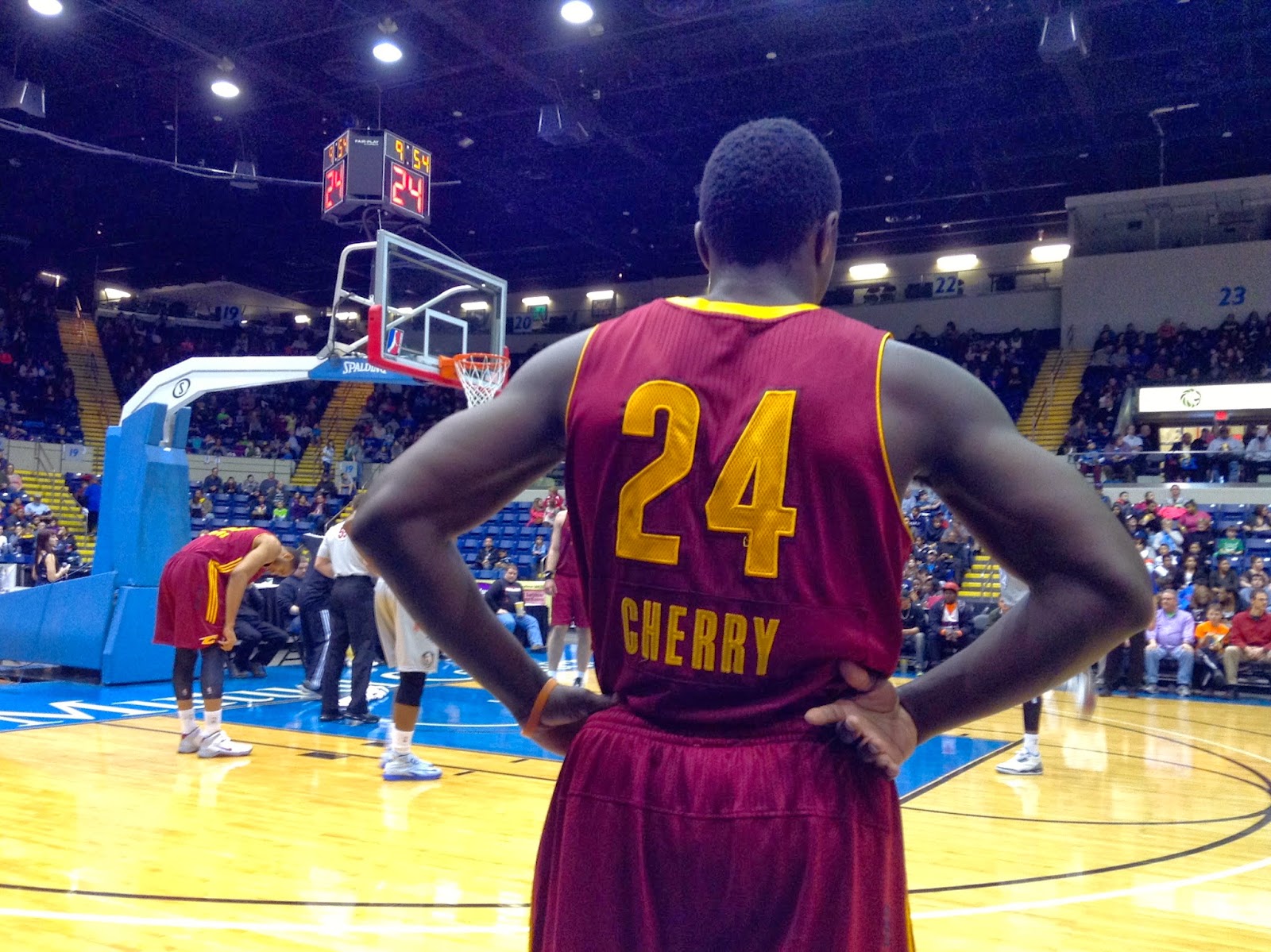
Like last year's trip, the price of D-League tickets this year was way lower than my Wizards season tickets; I quite honestly splurged for these tickets, opening up my wallet and spending $80 for my courtside seat. That seat in Washington will cost Wizards season ticket holders $1,650 per game next year. I love courtside seats and I'd love to spend one game sitting there in Washington someday even though I know it might cost a ton of money. The only drawback to courtside seats is the constant walking back and forth and standing in front of you that the coaches and players engage in. It makes watching the game challenging sometime, as shown at the top of this post and just below.

Even though the seat cost was lower, one thing comparably priced in the arena to the NBA level was beer, although the MassMutual Center's 20 fl. oz. domestic beers were a little more reasonable at $7.00 per cup than at Verizon Center (where they are $8.50). The best part of the beer sales action was the fact that Molson Canadian was considered domestic along with Bud Light and similar light-ish beers. Ironically, Samuel Adams, brewed in the same state as Springfield, is considered an import and costs fifty cents more. I stuck with the Molson!

Um, coach, can you move a little so I can watch the game?
I found that hoops in Springfield is much like Frisco, Hidalgo and Austin was last year, although it was nice to find the venue in a downtown area rather than in a suburban setting. The arena was about the same size as those three places but, unlike Frisco and Hidalgo, was equipped with a  center scoreboard and replay monitor. The place was packed, mostly with kids since it was apparently some kind of Read To Achieve event that included a several minutes long parade of what seemed like 500 or so kids around the perimeter of the court. It was also Fan Appreciation Night, which may have had an effect on the attendance. I was disappointed that we missed Superheroes and Fairy Tales Day by a couple of weeks. That would have been fun to see. They don't have that sort of event in D.C.

Watching D-League basketball in a filled, lively arena that looks like the MassMutual Center does on the outside makes it easy to forget what kind of desperation some of the guys on both teams are playing with. It looks so polished and professional despite the size of the arena. I just had to keep reminding myself that these guys are playing for something akin to minimum wage, just hoping to get to the NBA and some sort of reasonable payday. 

Some of the players are honestly just living out a dream, chasing something that likely won't ever happen for another year or two before moving on with their lives and hoping to land a career or at least a job. Others are former NBA players trying to get back into the league and the rest (which is a very small minority) are working hard and hoping someone at the NBA level notices something about their game which fills a spot on their squad either for game action or just to provide a body in practice. There's a lot of risk and very little hope at this level of ball but that very little hope is keeping some of these guys going day after day for probably less than $20,000 for a season plus some sort of per diem.

The game itself was competitive, probably the most exciting D-League game of the four I saw to this date, with the home team winning behind a strong third quarter where they pulled away and held on despite being down two at the half. Unlike some of the games I saw last year, which featured players I knew such as former Wizard Shelvin Mack and then-Rocket Royce White, there was nobody I was particularly focused on watching in this game on either team. Devin Ebanks, who was drafted by the Los Angeles Lakers in the second round of the 2010 draft and was a top D-League prospect, was inactive for the Armor (I think honestly he quit the team). The only other recognizable name on either team was the visiting Canton Charge's Kyrylo Fesenko, who played four years with the Utah Jazz from 2007 to 2011. Although he played, he had little impact on the game despite his 10 rebounds.  I can't see him making it back to the NBA. He just doesn't look like he's in good enough shape to do so.

It ended up being a fun night and I'm glad I stopped in Springfield to find a place I never really knew and see some more D-League ball. Often when I travel, I have chance meetings with total strangers that enrich my trip. On this trip I actually had a chance meeting with a friend, which is astonishing to me that I would know someone in a 7,000 seat arena hosting a minor league basketball game. Through the magic of Facebook, with me lamenting a pre-game meal in a local bar festooned with New England Patriots and Boston Red Sox memorabilia, I found out my friend and fellow former Marillion obsessed fan Jeremy, who I knew from architecture school would be at the game with his son. It was good spending a half hour or so courtside catching up on some old times and current goings on. Worth every penny.

Catching up with an old friend courtside in the second quarter.