Showing posts with label NBDL. Show all posts

December 28, 2019

Minor Leagues


Last month, Major League Baseball (MLB) announced plans to potentially reduce the number of Minor League Baseball (MiLB) teams across the United States by 42. Considering the number of MiLB teams out there stands at around 160 or so, 42 is quite a cut. MLB claims this will save them a ton of money and they might be right. I've read that the cost savings might be around $22 million or so per year. I've also read that Major League Baseball brings in revenue of about $10 billion per year. $22 million divided among 30 teams pulling in $10 billion seems like small potatoes to me.

Understandably, there has been some backlash to this plan, particularly from the communities which stand to lose their baseball teams. Think this isn't important? I disagree. Access to live professional sports for communities is sometimes vital for community pride and social connection. It has been for centuries. Take away the Pioneer League (which is part of the contraction plan) and you've just wiped out professional baseball in Montana. Like all of it. So maybe not that many people out west care about a rookie league or any other team that's being run out of business, but I bet some do. And not just the owners of the teams (MiLB teams are not owned by parent organizations) and the communities that have financed stadiums for those teams. Although those two groups might have a pretty strong opinion of Major League Baseball telling them they are out of business.

Need any other reasons why this sucks? How about tradition? The Chattanooga (Tennessee) Lookouts are on the chopping block with this proposal. They have been the Lookouts since 1909 and their franchise dates back to 1885. They might have survived without MLB affiliation in the early 20th century but today that might be a different proposition.

So why am I writing about baseball on a Washington Wizards blog that's supposed to be about basketball? Well, because I think this same sort of thing has been going on for the past few years in the NBA's minor league system, the G League. Not the contraction (because the G League has actually been expanding) but the removal of professional sports from towns and cities with little to no access to that kind of thing once the NBA moved their teams. And I'm arguing what the G League is doing pretty much sucks too.

Erie Insurance Arena: Home of the Erie (PA) BayHawks. For now.
Consider this: at the beginning of the 2009-2010 NBDL season (the NBDL or National Basketball Development League was what the G League used to be called before corporate sponsorship got involved) had 16 independently owned and operated teams spread out over 14 states. Of those 14 states, seven of them had no NBA team so the NBDL was all they had. Of the nine teams located in NBA states, one (the Tulsa 66ers) was in their state before the NBA was (on a permanent basis, anyway) and two of the other teams (in Hidalgo, Texas and Bakersfield, California) were hours by car from the nearest NBA arena, which made access to live pro basketball an overnight or very late arrival home affair. Point is, professional basketball was available to people in the United States without having a visit an NBA city.

Fast forward to today and the G League looks much different. There are now 28 teams in the league which from a growth standpoint is awesome. But all of those teams are now owned by NBA franchises and just six of those 28 teams are located outside the state of their parent team. Considering one of the remaining six is the Memphis Hustle which plays just over the Mississippi border about 12 miles from Memphis but is named after the city where the NBA team plays, it's really just five remote teams. Of those five, just four are located in states without an NBA team. I think things are trending in the wrong direction there.

When the NBDL was launched in 2001, it was deliberately located in the underserved (from a professional basketball standpoint anyway) southeast of the country. At that time there were other non-NBA affiliated regional leagues (notably the Continental Basketball Association (CBA) centered in the midwest of the country) around the United States but I guess the southeast stood out to the NBA as an area of opportunity. Plus I imagine locating all eight charter members of the league in Virginia, North Carolina, South Carolina, Georgia and Alabama cut down on travel expenses.

It didn't work. Within four years, two of the franchises had folded and four of the other six had moved. The two that remained in place? Gone one year later. New teams were added in Arkansas and Texas and they too went belly up after just two years in business. Not such a good idea to start a basketball league in the southeast apparently.

Inside the rockin' Portland Expo Center.
Obviously, the league was able to weather the poor start, likely because it had the backing of the NBA. Original franchises which had re-located to Albuquerque, Austin and Tulsa were more successful in their new locales than their original cites and in 2005, the league engaged in a serious expansion, fueled in part by the defection of four teams from the CBA, to bring the total number of franchises to 12. Three years later it was 17. The league that started in the deep south now spread from Los Angeles to North Dakota to Portland, Maine. And they had taken the CBA out along the way and stood as the only serious minor professional basketball league in the country.

Things were good. Good for basketball fans. Good for small cities which needed professional basketball. Good for the NBA.

Then things started to go downhill. Maybe not for the NBA. Maybe not for the players. Maybe not for the owners of the teams that were suddenly being offered large sums of money for their teams. But for fans in small cities...for sure. In 2011, the Boston Celtics entered into what would be known as a hybrid affiliation with the Maine Red Claws. Under that arrangement the Celtics got to run the operations of the team and install their own coaching staff. That meant they could coach their G League assignees in the exact same system they were using in the NBA. Huge advantage to have that kind of control.

Two years later, the Knicks founded their own G League team. That slowly became the new norm. One by one (well except for the Denver Nuggets and Portland Trail Blazers) teams were either added to the League (typically in very close proximity to the parent club) or NBA teams purchased existing franchises and moved them. 

Dakota Wizards? Gone from North Dakota to be close to the Warriors who bought them. Replaced by...nothing. Reno Bighorns? Also gone. Moved to Stockton, CA to be close to the Sacramento Kings. Idaho Stampede? No more (say hello to the Salt Lake City Stars)! Get the picture? How about in Oklahoma where the Thunder actually moved a team from Tulsa to Oklahoma City. That's 107 miles away. Did they really need to move that team?

The Springfield (MA) Civic Center, no longer home of minor league basketball.
I have never visited Bismarck, North Dakota or Reno, Nevada or Boise, Idaho during basketball season or at any other time in my life. But I have visited Hidalgo, Texas and Erie, Pennsylvania and Canton, Ohio and Portland, Maine. They are all cool little cities who showed up to root for their basketball teams, no matter that they were in the G League. All of those cities fortunately still have their teams (except Hildago - the Rio Grande Valley Vipers moved to Edinburg about 20 miles away) although Erie will lose theirs at the end of this season.

The Celtics, I guess to their credit, didn't move the Red Claws (awesome name by the way) from Maine to Boston but instead keep them in the old 1915 Portland Expo Center. I saw that team play on a Sunday afternoon in the middle of winter and the place was filled. If any team saw the atmosphere inside that place I kind of believe they would think twice about moving that team. Maybe. Probably not.

While I have never been to Bismarck, Reno or Boise, I have been to Springfield, Massachusetts. I was there in 2014 to see the Springfield Armor play in their final season, right before the Detroit Pistons bought the team and moved it to Grand Rapids. With no offense intended toward the place where basketball was founded, Springfield is dead. In the two days I was there (small sample size I know) the streets were empty and decidedly not alive. Except before and right after the Armor played. The NBA took that away.

So I know I'm being a little melodramatic here. I mean, it's not like the NBA forced all these team owners to take millions of dollars for what were probably barely profitable teams. On the other hand, I'm not. I really believe in the power of sports to bring people and communities together. And I think the NBA has played a role in taking that away from some cities and towns. Just like Major League Baseball will if their plan to contract their (admittedly much more extensive) minor league system goes forward. They should stop it.

So should the NBA. But they probably won't.

The cover photo of this post is the logos of six of the original eight NBDL teams. 

March 16, 2017

Does Everything Have A Sponsor?


There was a time when I loved American advertising. When I first moved here as a kid from England in 1979 one of the things I loved most about the United States was that there were conspicuous and unapologetic posters, commercials, billboards, signs and everything else you could imagine urging you to buy! buy! buy! whatever it was they were selling. Coming from a more reserved society where the primary TV channel didn't even advertise anything, America in the late '70s was a breath of fresh air for a kid ready to fall in love with blatant commercialism.

38 years on, I feel differently. Sure, I still love the art and flashiness of billboards and signs and even TV commercials. I'm especially a sucker for beer advertisements. I have a few signs and other things scattered about my condo and a whole collection of other breweriana stowed away under my bed just waiting for the right time to bring it out into the light of day. But lately, and especially in the NBA, I feel things are going too far. I remember (and here I'm going to sound like I'm about 75 years old) back in the day when signage was reserved for select spots at Verizon Center; now it seems like it's everywhere.

Check out the ends of the arena where the Wizards play their home games and all you will see is Etihad Airlines signage. Look to the court for the Verizon logo. Walk in the main entrance on F Street and you can't help but see the primary advertising partners of the building just to the left of the doors. Park your car in the building and you'll be in the Lexus Garage.

Even the stanchion behind the basket is festooned with commercials. Earlier this season you could get by with the Tissot shot clock, the State Farm logo on the horizontal arm right behind the basket and the rotating video display a little bit further back. But then Libman, who apparently makes mops, took over the rest of the portable backboard, complete with a pair of Libman outfitted floor wipers at each end of the court. We've come a long way since the days when the team used to wrap a towel around a squeegee to clean the sweat off the wood. In Toronto they've taken it one step further and sold advertising space on the top of the backboard. I'm sure the Wizards will get there eventually.


And here's a news flash: it's only going to get worse. Next year we are going to see advertising patches on the players' uniforms, a la English soccer or the WNBA, although admittedly not as prominent as they are on either of those sports' kits. Not yet anyway. The Wizards haven't announced which company's logo will be inartistically plastered on the upper left shoulder of our players' jerseys. My money is on Etihad or MGM, for the record. As if all that wasn't bad enough, there's going to be a Nike logo on there as well, the first time the NBA has allowed a manufacturer's label on their shorts or shirts. All this while ticket prices continue to go up. This league is almost literally minting money.

But I'm not writing this post to complain about corporate sponsorship of the building the Wizards play in or the clothing they wear while doing it. And I swear I really sound like I'm some crusty remember-when septuagenarian.

Boston's 2017-2018 kit, complete with green and white GE logo. Ugh...
No, I'm writing this post to complain about what they did to the NBA Development League last month when they changed the name of the league. That's right, starting with the 2017-2018 season, the NBDL or D-League won't be called that anymore. Starting this fall, it's going to be known as the G-League, which is short for the Gatorade League. They sold the naming rights to the whole freaking league. And I'm not on board.

Now this is not without precedent. For years, England's Premier League, the top soccer league in the world, was known as the Barclay's Premier League because it was sponsored by the bank of the same name. But they have since recently abandoned the sponsorship and the league hasn't seen fit to replace them with a new sponsor, despite the 40 million pounds in lost sponsorship money per year. I get this is not the NBA we are talking about picking up a sponsor, but it's a slippery slope, especially when Gatorade have taken over the entire league title. I could see it being the Gatorade D-League or something like that but that's not the way it's going.

There are a couple of good points. First, I guess I'm OK with more sponsorship at the minor league level if it keeps it out of the parent league. However, since the NBA gets more and more sponsored each year, I'm not optimistic it will. I can easily see a day a decade or so from now when it's the Kia Association (or the K-Association?) or something similarly nonsensical as that. Second, players are no longer going to have the stigma of being sent to the "development" league, like it's some remedial performance improvement plan. I'm not sure the G-League is worlds better but it doesn't sound like a punishment anymore.

I also have to wonder will any other sports beverages be permitted in the G-League other than Gatorade? Will Powerade or similar brands be allowed at all or maybe just with their labels removed? Of course, it didn't seem like Powerade did LeBron James any good in game one of the 2014 NBA Finals but I guess some players still might opt for a brand other than Gatorade. Is there going to be that much separation of church and state in the G-League?

As if all that weren't enough, Gatorade even got the logo of the league changed, from the right leaning red, white and blue (to match the NBA) D-League player dunking logo to a monochrome more upright logo.

I'm not a fan of any of this. I'll take the advertisements plastered all over the walls, floors and ceilings (including the underside of escalators) of Verizon Center. I'm even OK with Libman mops shirt wearing floor wiper guys. But I think selling out an entire league by changing the name and logo of the league is just too much. Call me old-fashioned if you will.


New logo. I'm not on board. Isn't the name as a prefix to the league name enough? Guess not..

January 15, 2017

Free Fries!


For the past few years now, the Washington Wizards and Chick-fil-A have been engaged in a promotional partnership. The deal is if a player on the visiting team misses two consecutive free throws during a single trip to the charity stripe in the last quarter of the game, all fans in attendance get a free chicken sandwich from a local branch of the restaurant chain sometime in the following week.

I love this promotion. It gets fans cheering and making noise while our opponents are shooting free throws towards the end of the game when every point counts. Yes, it's a little shameful that this opportunity for some free grub gets the notoriously silent and indifferent crowds at Verizon Center worked up into a rabid frenzy. But look, noise is noise and I'd love it if the Wizards had a different sponsor behind a different giveaway related to free throw misses in every quarter. It might be complicated and less effective from an advertising standpoint, but we'd get the arena loud every quarter of the game. And let's face it, most nights the Wizards sorely need this.

Other folks don't love the Chick-fil-A sandwich giveaway as much as I do. The apparent contradiction between the home fans at VC making way more noise for a free piece of fried chicken on a bun than for the team itself has been covered in multiple news outlets including The Washington Post, USA Today and SB Nation. Again, I get that lack of crowd noise is a problem at Wizards home games; just don't blame Chick-fil-A for pointing it out. It's not like if they didn't have this promotion that the place would be loud all night long.

Last month, I took a trip out to Erie, Pennsylvania to watch the Erie Bayhawks, the city's NBA Development League team, play a game on a Saturday night. And I have to tell you the Bayhawks and McDonald's have just the promotion that I wish the Wizards would have.


Here's the deal in Erie: if the opposing team misses five free throws at any point in the game, then each fan in attendance gets a small fries from an area McDonald's for free. Why is this better? Well quite simply because it works potentially throughout the entire game. From the very first trip to the line for any player on the visiting team, there's a possibility to get closer to the goal of free stuff. Even if they miss the first free throw (which means no chicken for sure at VC), you can still cheer like crazy for a miss on the second during the fries promotion because each miss gets you closer to free fries.

Now I get it: a Chick-fil-A sandwich is way better than a small fries at McDonald's. Who even orders small fries anymore anyway? But why can't the Wizards get Mickey Ds to change their current McGriddles promotion (free McGriddles if the Wiz are ahead after one quarter) to a fries promotion based on free throw misses and have it count for the first three quarters only. I mean, who eats McGriddles? Does anyone like these things? It would be even sweeter if McDonald's made it a medium fries.

If the Wizards could make this change, we'd have some part of Verizon Center booing the opposition to get closer to free food every time they stepped to the line. McDonald's would take care of the first three quarters and Chick-fil-A would still get the fourth. I'd make this change in a heartbeat if I was running things. Some folks are still going to hate it. I love anything that gets people to make noise in support of the Wizards at home. For my part, I'll continue to boo for missed free throws in the final quarter, even though I've never cashed in on free chicken and realistically probably never will. Go Wizards!


January 10, 2017

The Bayhawks' Last Stand

 
Last month I took a quick trip to eastern Ohio and western Pennsylvania to watch some NBA Development League hoops. This is not the first trip I've taken a trip to watch minor league basketball and I don't expect it will be the last.

Each time I've seen a game in some new town, I've written a blog post about my experience where I've chronicled the history of the home team; talked about the arena; and maybe elaborated on one or two experiences while I was in town that made me feel like I was in a unique place in the United States. There's sort of a formula to those posts. I did that last week when I wrote about our first D-League stop on that trip in Canton, Ohio.

But my plan for writing about my trip to Erie, Pennsylvania to watch the hometown Bayhawks take on the Westchester Knicks was a bit different. I was going to go off script a little and use my trip there to talk about something else. And that was whether a franchise like the Erie Bayhawks was likely to survive what is happening in the current NBDL as the league expands and its members are more often that not wholly owned subsidiaries of NBA teams. But then the Orlando Magic beat me to it and announced last month that starting with the 2017-2018 season, the Erie Bayhawks would be moving to Lakeland, Florida, presumably with a new name since Lakeland does not sit on a bay.


I think the Bayhawks moving to Florida is tragic. Yes, I know it's only minor league basketball and that Cleveland is about an hour away if someone from Erie wanted to go to an NBA game. But sports are important to communities and stripping a town of a professional sports team, no matter how minor league it is, is not something to be celebrated.

Let's take a look back at how we got here. The NBA Development League started as the National Basketball Development League in 2001 with eight teams located in the southeast of the United States and none of these teams was owned by an NBA franchise. Sure the league had the endorsement of the NBA and operated on a sort of a farm system basis by allowing NBA teams to assign players to the D-League but there was little actual visible meddling.

I believe one of the original ideas behind locating the NBDL in the southeast U.S. was that the NBA saw an area of the country mostly crazy about college hoops completely underserved by professional basketball of any sort. With the Continental Basketball Association already in place in the midwest, the NBA chose southern Virginia, both Carolinas, Alabama and Georgia as the place to start its league. It wouldn't stay there long. There's only so much chance of making two pro hoops teams in Alabama viable year after year. To that point, once of the two Alabama teams (the Mobile Revelers) failed after just two years, along with the Greenville (SC) Groove.

In 2005, four years after its first season, the D-League expanded back to eight teams and moved west, adding one team each in Fort Worth, Texas and Little Rock, Arkansas and seeing three of the original eight teams move to New Mexico, Oklahoma and Texas. A year later, they would expand into the midwest, the Continental Basketball Association's territory, when the CBA's Sioux Falls (SD) Skyforce, Dakota Wizards and Idaho Stampede jumped ship from the then in trouble and ultimately failing league.

At the start of the 2008-2009 NBDL season, things seemed to have settled down. The D-League had expanded to an all time high 16 teams despite the loss of the remaining three original teams and the demise of the Fort Worth and Arkansas franchises after just two seasons. It seemed like the league had a comfortable footprint nationwide and the instability that had characterized the league's first few years seemed to be in the past. Sure the Anaheim Arsenal moved to Springfield, Massachusetts after that season and the Colorado 14ers went bust but the addition of the Maine Red Claws got the league back to 16. No worries, right?

Over that period of the D-League history, three of the teams in the league had been sold to NBA franchises. The Los Angeles Lakers bought the Los Angeles D-Fenders; the San Antonio Spurs purchased the Austin Toros and the Oklahoma City Thunder acquired the Tulsa 66ers. For the first time in D-League history, teams were single affiliated with an NBA franchise which allowed the franchise to install the big league offensive and defensive schemes at the minor league level and really develop their D-League assignees in a targeted fashion. It just so happened that the teams these three franchises bought were located close to the parent team's city.

Say goodbye to the bouncy castle, children of Erie. The Orlando Magic don't care.
Then in 2010, something different happened. Donnie Nelson, an executive with the Dallas Mavericks and son of legendary NBA coach Don Nelson, moved the Colorado 14ers (he had bought the defunct franchise a year prior) to Frisco, Texas, just a little more than 25 miles from Dallas and the Mavericks became exclusively aligned with the minor league franchise. This was different than a team buying a local team and keeping it in the city where it was before the purchase. Now, an NBA team had moved a D-League franchise to be super close to the NBA team's home.

It caught on. Two years later the Golden State Warriors purchased the Dakota Wizards, a team that had been playing in Bismarck, North Dakota since 1995 (!!) and moved them to Santa Cruz, because they needed a team closer to them so they could develop their young players. 17 years in one place and then poof! Gone!

The race was on. Springfield Armor? Sold to the Detroit Pistons and moved to Grand Rapids, Michigan in 2014. Bakersfield (CA) Jam? Property of the Phoenix Suns and relocated to Arizona as the Northern Arizona Suns (yawn name!). What about the Idaho Stampede, another CBA-era team? Moved to Salt Lake City by the Utah Jazz. Then this season the Reno Bighorns became the property of the Sacramento Kings with a promise to move them closer to Sacto. Finally (although not really) it was the Erie Bayhawks' turn on December 14 of last year: moving to Lakeland, Florida effective 2017. 

Next year there will be no pro hoops in Erie, Pennsylvania. I'm sure not many people really care about that. I'm pretty sure the Orlando Magic don't care much at all. But I've been to Erie on a game night (as I had been to Springfield three seasons prior) and I've seen people from parking garages and restaurants and bars make their way to the Erie Insurance Arena to cheer on their Bayhawks. This stuff matters, folks. And right now the NBA teams are focusing all their energy on moving local franchises as close to their home arenas as possible. And I don't hold with it.

As of the beginning of the 2017-2018 NBA Development League season, there will be just three D-League teams located more than 150 miles from their parent clubs: the Rio Grande Valley Vipers (about 350 miles from Houston); the Iowa Energy (600 or so miles from Memphis); and the Sioux Falls Skyforce (more than 1,000 miles from Miami). Watch out Sioux Falls; you are probably going to lose your team at some point very soon.

I loved visiting Erie for an afternoon and evening. The Bayhawks, despite giving up an early and seemingly insurmountable lead to the visiting Westchester Knicks fought back hard (with maybe a little help from the refs) and had a chance to win it at the end. Despite the bottom of the league status of the team, the Bayhawks' faithful (including me, sometimes between bites of the arena's poutine) made a ton of noise for the team that night. Next year, it troubles me that those same fans won't have a team to root for. I think it's great that the NBA Development League is evolving into a true minor league; I'm just not happy about the effects on small cities like Erie.

Poutine in Erie. Way better than Verizon Center's version of a couple of years ago. Closer to Canada, eh.

January 3, 2017

Canton


Since I started this blog in 2012, I've made a concerted effort to make it to at least one NBDL game each year. By and large (but not always), I've been successful in taking some time off to watch pro hoops below the NBA level. Last month, I took my fourth road trip in five seasons to the underbelly of the NBA. I stopped in Cleveland for one night (which I've already chronicled here and here) and then moved on to somewhere which I thought would be a little less cosmopolitan: Canton, Ohio. Turns out I might have been wrong.

I should probably start out by saying years and years ago (OK...decades ago) I really really wanted to make a trip to Canton because the Pro Football Hall of Fame is there. This was a time when football (and the New York Jets) was my number one sport, like when I was in high school and college. But as time passed, my urge to travel to Canton to visit a museum faded until the D-League resurrected my interest a few years ago. Finally I got to go and check the place out. The Canton-Erie NBDL swing has been on my radar for years.

So the point of making the run to Canton was obviously to see a Canton Charge home game. Canton is one of three original teams remaining in the NBDL (now the NBA Development League but I will continue to use NBDL), along with the Austin Spurs and the Oklahoma City Blue. Neither the Spurs nor the Blue (dumbest team name ever?) nor the Charge started their lives in their respective cities. The Charge started out in Huntsville, Alabama as the Huntsville Flight (awesome name, after the city's early space program history) before moving to Albuquerque and later Rio Rancho and becoming the Thunderbirds (also an awesome name) before finally landing in Canton as the Charge (NOT an awesome name), where they have been since 2011.

Considering the brief history of the D-League, the Charge's predecessor teams were relatively successful, making the Finals in 2004 while in Alabama and winning the whole shooting match in 2006 in their first season in New Mexico. Today, they are the D-League affiliate of the hated (by me) Cleveland Cavaliers as a wholly owned minor league franchise, meaning of course that Dan Gilbert is the owner. And let me say as a basketball fan if there's an owner I dislike more than Dan Gilbert, I'm not sure who it is. This dude proved he's petty and mean in his reaction the LeBron James bailing on the Cavs in 2010 and now loves everything to do with James now he's delivered him a title. And I don't say this because buying tickets for a Charge game in advance required me to use a special app on my phone and charged what I consider to be a worse than Ticketmaster fee on top of the gate price. Enough ranting. For now.

The Canton Brewing Company in downtown Canton. I'll explain later how awesome this place is.
Canton is one of those cities in the midwest's rust belt, a former center of manufacturing (originally agricultural implements and later iron) along a railroad route which has seen employers move their operations to places where it costs them a whole lot less to employ workers to make their products. Living in upstate New York for nine years I saw towns up and down the Erie Canal and Hudson River struggling with these same issues. The harm it can do to a community is significant.

The city was founded in 1805 and was named after the province in China with the same name. I know; totally random, right? Apparently the place was named by the town's surveyor after a trader whom he admired who had conducted business in China. Go figure. Other than its former place in American manufacturing history and its current place as the home of the Pro Football Hall of Fame, the town is also the adopted home of President William McKinley, who practiced law in the town before making a successful run at the Ohio governorship and then taking his talents to Washington as the Commander-in-Chief. It's pretty obvious when you are there. There are a lot of things named McKinley.

Considering the history of Canton and what I assumed would be an empty downtown center, I was a little apprehensive about my choice of hotels in the city. I love staying downtown in cities because it allows me to walk the city before and after the game (including to the arena) and really get a sense of what it's like to be there. While there seemed to be a number of chain hotels out near the Pro Football Hall of Fame, the choices for staying downtown seemed to be one: the McKinley Grand Hotel, which sounded pretty fancy but came with a decidedly un-fancy less-than-$100 per night price tag. Driving into the city pocked with vacant lots and a mixture of Richardson Romanesque (which is amazing) and late 1960s / early 1970s American concrete-heavy brutalist architecture (which is not amazing) didn't make me feel any better.

There's a reason I travel and the biggest reason is so I can go to places and make my own mind up what it's like to be there. And I have to say Canton is the greatest little town and the hotel was a good reflection of the town's overall spirit. Sure it looked a bit run down and the pool deck inside the hotel on the second level  with sliding glass doors leading directly to guest rooms seemed like it was an idea conceived in the early 1980s (it probably was) but other than that it was fine. Definitely worth less than $100 a night, which included free buffet breakfast. Just get to breakfast early. It's buffet but it runs out. I made it there before they ran out and filled up; my friend Bryan was less successful.

Also, if you are a D-League traveler like me (and look, I know probably nobody else out there goes on these crazy minor league hoops trips), the visiting team seems to prefer to stay at the McKinley Grand. Both the Raptors 905 team (which was the Charge's opponent the night we were there) and the Long Island Nets (opponent on the second night of the homestand) were bunked up at our hotel. I even got to say hi to former Wizard and current Raptors 905 head coach Jerry Stackhouse in the lobby. 

Just an aside here. I shook hands with Jerry Stackhouse when he played for the Wiz about a dozen years ago and I have to say he had the softest hands I've ever shaken. I don't mean smooth, although they were. I mean like pillow soft, like his hands were filled with air. I shook hands again in Canton and they are definitely less soft. Maybe it's the age or maybe the Wizards have something special in that locker room.


The Canton Charge play their home games just down the street from the McKinley Grand at the Canton Memorial Civic Center. The building was built way back in 1951 and it is definitely of its time. The materials used are brick and stone on the exterior with glazed masonry inside along the concourses. Speaking of the concourses, they are extremely tight which is hardly surprising; I can't imagine concessions was the number one priority for arena design back in 1951. 

This is a great old building although I guess my one time visit and sense of nostalgia affected my judgment here. The main space was clearly built not for basketball but for performances on the stage at the west end of the arena. It works for hoops because the seating is all parallel (or perpendicular depending on your perspective, I guess) to the court, rather than being oriented towards the west end.

Despite the last paragraph, I can't get on board with the space frame inserted just below the roof structure and shown in the picture below. Those things have no place in architecture, whether being used as structure or just as decoration as they are at the Civic Center. Not good. I'm thinking it's a 1970s or 1980s addition.


The on court action that night was nothing much to write about so I won't write much about it. The Charge got killed by Raptors 905 (does this get abbreviated to "Raptors" or "905"?) by a score of 104 to 72. We kicked back and took it all in anyway along with a couple of Long Island Nets players sitting right in front of us in the smallish Civic Center seats. This is probably the first time I've attended a D-League game where I didn't root for the home team. I just couldn't; see the Dan Gilbert comments above. I didn't overtly root for the 905 either though.

That report wraps another NBDL game. That's six of the current 22 teams I've seen at home so far. Hopefully this thing settles down soon and teams stop moving around. It's getting close I believe which might have negative consequences for some communities but we'll get to that soon. 


Some final notes about Canton.

First of all, this place has a lot of soul. The city is not dwelling on the urban flight that took place in the last quarter of the 20th century. Instead, it has re-imagined itself as an arts town and has both public art displays and numerous galleries scattered around town. So despite the relatively empty feeling to some blocks, what is there is really cool and interesting. I hope it continues to develop and draws residents back in. There's clearly more than hoops happening at the Civic Center and the Palace Theater a few blocks down Market Avenue seems to be really promising.

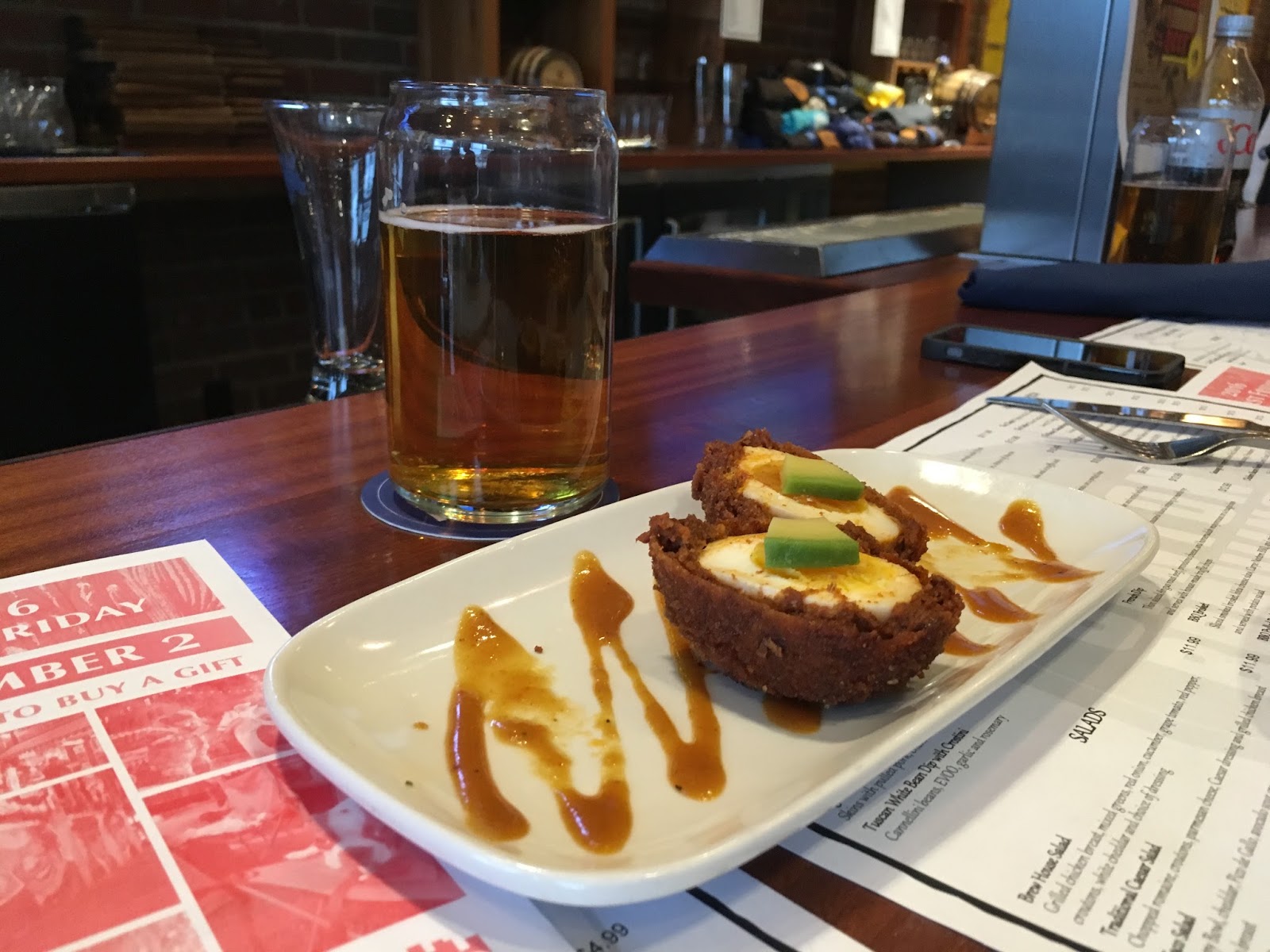
Second, there are some awesome bars in town, which let's face it for me influences how I feel about a place a great deal. We had some drinks and snacks at the Canton Brewing Company down on Third Street before returning for dinner later the same day. The food was overall very good but the Scotch eggs (shown above) were maybe the best I've had (like ever!); it was the chorizo, I'm sure. Canton was a big brewing town at one time and one of the great things that Canton Brewing is doing is honoring the history of the town's beer making by replicating logos of historic beers of Canton on their glasses; I came home with two. Plus a metal brewery sign. Couldn't resist. The logo is incredible.

If you need a great place to hang out later in the evening, I'd recommend Conestoga Grill, which is a dark somewhat dank bar with some local beers on tap plus Heileman Old Style in 16 oz cans. And in case you are wondering, dark and somewhat dank are the best qualities one can find in a bar so those are compliments. Thanks to Natalie over at Canton Brewing for not only serving us over on Third Street but also pointing us to the Conestoga.

Finally, there's a nut and chocolate place in town named Ben Heggy's. I found this place while i was wondering around town the morning after the game and the smell of roasting nuts was irresistible. Unfortunately for me, I was out too early and the place was closed. But I ordered some for the holidays based on the smell alone. The one pound of mixed nuts I got mailed to me lasted barely a day and a half at my parents' place. I'll need two or three pounds next year, at least. I recommend you pick some up if you are ever in town.

What started out as a visit with a little apprehension on my part worked out about as well as it could. If it wasn't obvious, I'd go back to Canton in a second. Until then, I'll just keep mail ordering from Ben Heggy's. Great D-League stop. The best ever!

Hey, Mike! Show everyone how Wizards fans feel about the Cavs and their overrated point guard!

March 26, 2016

22 And Counting


These 2015-2016 Washington Wizards just don't seem to want to be playing in the postseason. Last night's double overtime loss to the woeful Minnesota Timberwolves means that the Wizards have now lost to two of the three worst teams in the Western Conference at home. They are now 3-1/2 games behind the Detroit Pistons for the eighth spot and seem to have about as much chance of making it as our starting shooting guard did of making a bucket in the second half last night. You can't score if you don't try, folks.

So with all that said, it's time to think about potentially happier times in the future, albeit something else the Wizards are sort of bungling at the moment.

At the beginning of the 2015-2016 season, there were 19 teams in the NBA Development League, the NBA's minor league of sorts that is rapidly morphing from a series of independently owned franchises with loose ties to the big leagues into a bona fide farm system. This season is the first year that all the D-League franchises have a single affiliation with an NBA team. That means the 19 NBA teams which have signed up for this deal get to assign younger players to a team where they can play which is also operated with the exact same defensive sets and offense schemes as they run in the show.

The Wizards, in true franchise underperforming seemingly always behind the times character, are not one of the 19 teams with this unique development advantage. That means they can't send someone like Kelly Oubre, Jr. anywhere to get him more playing time which reinforces what the Wizards are doing on NBA courts. They have to rely on meaningful in game situations for short spells or relatively meaningless end of game blowout win or loss scenarios where Kelly inevitably fouls too much and shoots too much or too poorly or both. The rest of the time, he's riding the pine watching and practicing with the big boys. Not saying that isn't valuable but it's not real playing time.

Next year, the NBDL will expand to 22 teams. Of course, the Wizards aren't one of those teams who are expanding. Our hometown franchise seems to be content to wait until the team's new practice facility is complete which should be 2018, barring construction delays. That means the earliest the team would field a D-League team is for the 2018-2019 season. That's two more years at least of being underserved in this department.

Rendering of the Wizards new practice facility.
The NBDL played it's inaugural season in 2001-2002 and was located entirely in the southeast of the United States. The league operated franchises in Virginia, North Carolina, South Carolina, Georgia and Alabama and nowhere else. The league could realistically be viewed as a complementary league to the now defunct Continental Basketball Association which stretched across the Midwest of the country and followed similar regional basketball leagues that had existed for decades.

The teams in those two leagues had some crazy names: Greenville Groove, Roanoke Dazzle, Mobile Revelers, Flint Fuze, Dakota Wizards, Gary Steelheads. Some of the team nicknames were tailored to have regional relevance and others weren't. What you ended up with was a set of teams with names that existed pretty much nowhere else in professional sports and this has always been one of the most fun aspects of minor league sports for me. I remember living in Cooperstown in the mid 1990s and checking out all the minor league caps for sale in town. The Chattanooga Lookouts and the Lansing Lugnuts were always my favorites.

Since the NBA's gotten more involved in the D-League, the names have been toned down a bit. Sure the Sioux Falls Skyforce still exists in the NBDL from the old CBA days but all the original D-League teams are relocated or gone and the only other CBA city other than Sioux Falls that still has minor league basketball is Grand Rapids. And only since 2014, when the Detroit Pistons bought and relocated the Springfield Armor from Massachusetts. The Pistons elected to call their new franchise the Drive, to align with their parent team branding, rather than go back to the old Grand Rapids Hoops, which I would have loved.

So let's say the Washington Wizards buy into the NBDL and start a team in 2018. What are they going to call it? Let's take a look at some possibilities based on the four existing examples set by the 19 current and three future NBDL teams.

Model One: Be Unique
This is my favorite category because the identity of the D-League team is totally different from the parent franchise. This allows regional identity to be expressed in the selection of the team's nickname which allows local civic pride to shine through. Instead of feeling like the team is owned by some larger, more profitable organization, the team feels like it's a part of the community where they play. Half of the 22 teams which will play in the league next season fall into this category and they all, with the exception of the Maine Red Claws, pre-date the current one to one alignment trend.

The Fort Wayne Mad Ants are named after General Mad Anthony Wayne (the city's namesake), the Rio Grande Valley Vipers are named after a local reptile and the Reno Bighorns are named after the elusive sheep that live in the mountains around the city. The Erie Bayhawks, Canton Charge, Iowa Energy, Sioux Falls Skyforce, Texas Legends, Bakersfield Jam and Idaho Stampede round out this category. Each name has nothing to do with the parent franchise. I love it!


Model Two: Use The Same Name
In 2012, the Golden State Warriors bought the Fargo, North Dakota based Dakota Wizards and shipped the team west to Santa Cruz. They re-named the team (are you ready for this brilliance?) the Warriors. Other than the coincidentally named Wizards who had no relationship to my beloved Washington Wizards, it was the first time an NBDL and NBA team carried the same nickname and it started a trend.

Starting with the 2016-2017 season, the Brooklyn Nets, Chicago Bulls, Golden State Warriors, New York Knicks, San Antonio Spurs and Toronto Raptors will all be affiliated with a D-League team named the same as their franchise. The Spurs even renamed the Austin Toros to the Austin Spurs in 2014. There is generally no inventiveness here; the teams are just copying their names to spread brand identity and it's pretty obvious to me that's the intent. I don't like this except I think it's worth highlighting the Bulls and Raptors efforts here.

The Bulls new D-League affiliate will play in Hoffman Estates, IL and they wanted I guess to keep the Bulls brand. Suffice it to say that they probably didn't want the Hoffman Estates Bulls so they rolled out the Windy City Bulls. I'm not thrilled but it's better than Hoffman Estates. It kind of makes it sound like there are two teams in Chicago named the Bulls though.

Toronto's D-League team, which began play this year in Mississauga, Ontario, has also elected not to use the place name in their team name. But unlike Hoffman Estates, the Raps have decided to use the area code to I suppose identify with a broader audience. They rolled out Raptors 905 (yes, that's the name of the team) last fall. While I don't like this whole overt identification with area codes trend, I'll give them some props here for doing it differently.

Model Three: Use A Related Name
The Philadelphia 76ers are named after the signers of the Declaration of Independence which was signed (in case anyone doesn't know) on July 4, 1776 in (yep, you guessed it) Philadelphia. When it came time for the Sixers to rename the Utah Flash, who they bought and shipped cross country to Newark, Delaware, they chose the name 87ers, to commemorate the first ratification of the United States Constitution, which was signed in (wait for it...) Delaware in 1787. Same theme, different place, different name. Get it? Good!

The 87ers aren't the only D-League franchise that is named along this theme. The aforementioned Grand Rapids Drive and the about to start playing Greensboro Swarm (owned by the Charlotte Hornets) are in this same category. I like this as a nice compromise between "you WILL use our name" and "do whatever you want." It ties back to the main franchise but also allows a completely unique nickname for fans of the minor league franchise.


Model Four: Same City, Different Name
In the 2016-2017 season, there will be two D-League teams that will exist in the same city as their parent club: the Los Angeles D-Fenders and the Oklahoma City Blue. And they both use the same city name as the major league team. They could have come up with a more imaginative solution here like the Bulls sort of did (admittedly not facing the same problem but the example fits) but they didn't.

The result for LA and OKC is pretty much just blah. The D-Fenders I guess is a play on the league's name but the Blue??? Really??? I get the dilemma a team could be in. Without thinking outside the box, you automatically name the team after the city where it's located and both the D-Fenders and the Blue play in their big brother franchises' cities. But you can't really name your NBDL franchise better than your main team, right? And both these teams have less than impressive names. I'm not suggesting that they deliberately picked mediocre names but, well, yes I sort of am doing that.

So all that begs the question, what will the Wizards do? Will we get Wizards 202? Or the Washington Red (please, no)? How about letting the Sea Dogs, that finished as runner up to the name the Wizards contest in the 1990s, finally see the light of day and let those fools who voted for that name at long last cheer for the Washington Sea Dogs. I'm pleading that it be none of these.

The Wizards clearly can't use the same nickname for their future D-League franchise if they also want the name of the city they are going to play in as the name of the team. That would yield the Washington Wizards and nobody really wants that at all. In fact, I'd steer clear of Wizards and anything Wizards related. No Ward 8 Wizards or DMV Wizards or Capital Wizards or any other Sorcerers or Spells or Necromancers or anything else magical. Although I'd consider Ward 8 momentarily before realizing it was incredibly narrow (albeit potentially powerful) in its breadth.

So what to do? Well in addition to the suggestions above that I've already thrown in the trash, I wouldn't use any of the names that lost the naming contest in the '90s. This would throw out Dragons (not close to Chinatown where it might make sense), Express (because it sucks) and Stallions (also because it sucks).

I don't think the team will use Washington Bullets for a couple of reasons: they've steadfastly refused to consider a name change for the Wizards and Washington Sports and Entertainment nixed the idea for the Arena Football League franchise they bought pretty quickly, although admittedly it could be because they are saving the name for the D-League. A few years ago, I thought it would be cool if the team put a NBDL team in Baltimore and called them the Bullets. I don't see it working in Washington, although it would sell a lot of merchandise I'm sure.

So where does that leave us? Washington Monuments? I wouldn't put it past the Monument obsessed ownership group but it's awfully difficult to chant that isn't it? I think it would be cool to borrow a former Washington sports team's name and use that. Professional teams played basketball in D.C. under the Capitols and Caps names in the '40s and '60s but clearly that wouldn't work. Other teams like the Senators (Major League Baseball), Lions (American Hockey League) and Diplomats (North American Soccer League) don't seem like winners either.

If it were me, I'd go with Capital Bullets. That would harken back to the 1973-1974 season for the current franchise and the only time the team used that name when they first moved to Landover in 1973. It would also have some more regional appeal and wouldn't be confused with the throwback Washington Bullets memorabilia that the NBA churns out. Plus maybe they could finally make that division champs banner that's missing from that's year's campaign (along with a couple of others) and hang it in the new building. Just my suggestion. I'm sure I won't be listened to.

January 12, 2015

At Sixers And Sevens


During each of the last two NBA seasons, I've managed to take a break when the Wizards were on a west coast road trip and get away to watch some games in the NBDL, the league which is quickly morphing towards becoming a sort of NBA farm system the likes of which is used by the National Hockey League or Major League Baseball. Two years ago, I took a week long trip to Texas to see games in Frisco, Hidalgo and Austin; last year, I got away for a long weekend in New England to see my first hoops in Springfield, Massachusetts and Portland, Maine.

I love attending D-League games. There's something about pro hoops below the NBA level that appeals to me, at least once a year, anyway. I love seeing how different the environment is, watching guys play for a spot in the show and very often seeing a small town side of America. Sure, some of these games aren't exactly played in small towns, but they are smaller than Washington, D.C. so they are small to me.

I still want to take a D-League trip to the midwest to catch games in Erie, Canton and Fort Wayne and a California trip to see games in Los Angeles, Bakersfield and Santa Cruz. But this year, my NBA travel budget and schedule appeared to be too overbooked for a trip to the minor leagues. I've already made a trip to Toronto to see the Wizards play in Canada in November and before Christmas I was down in Miami to see us take on the Heat in an all too close game. Those trips, combined with an All-Star Weekend in New York, seemed to preclude any NBDL games this season.

But where there's a will, there's a way and a little more digging this season revealed an opening in the Wizards schedule this past weekend to allow me to squeeze a game in. With the Wizards having played Chicago this past Friday at Verizon Center (an awesome statement victory) and a matinee game in Atlanta on Sunday (a game which showed just how far we have to go), Saturday night was open and it just so happened the Delaware 87ers (or the Sevens as they are called) were at home in Newark, Delaware, for a game against the Fort Wayne Mad Ants, who just happen to be the Wizards D-League affiliate this season. It was just too close and too tempting to pass up.

Second quarter action from the Bob.
The Sevens have been playing ball in Newark for a little more than a season now. Their debut season was last year as the wholly owned affiliate of the nearby Philadelphia 76ers (insert joke here about the Sixers being about as good as a D-League team). The team struggled in their first year in Delaware posting a 12-38 record, good for last in the East Division. As of Saturday's game time this year, the team is doing a little better, sitting third in the brand new five team Atlantic Division with a 7-10 mark. When the Sixers bought the Sevens (don't think about that too hard), they were actually a dormant franchise. The 87ers began life as the Utah Flash in Orem, Utah who played in that city from 2007 to 2011 but folded after the 2010-2011 season. I have no idea how buying a dormant franchise differs from an actual expansion franchise, but that's how the team got to Newark.

The 87ers name is a reference to the year Delaware ratified the United States Constitution, the first state to do so. Since Delaware was one of the original 13 British colonies, it is pretty likely that the area in and around Newark has a pretty substantial history. And I guess that's true. Being around for a while builds history, I guess. The town was established in 1694 and officially recognized by the British government and King George II in 1758. Since 1833, the town has been home to the school that would ultimately become the University of Delaware in 1921, although it took about 11 years off for a stretch before re-opening. The enrollment at the University is about 20,000; the population of Newark stands at about 32,000. It's no surprise therefore that the town and the University are pretty much one and the same.

The 87ers play ball in the Bob Carpenter Center (or the Bob), which serves as the home for the University of Delaware's men's and women's basketball teams and the UD women's volleyball team. The arena sits approximately 5,000 people for a basketball game, although only about half those seats are available for a D-League game. With the reduced seating availability, it ends up being the smallest arena I've visited in my six NBDL games seen to date, coming in at even smaller than the tiny Portland Expo Center I visited last year, which seats a little more than 3,000 in bleachers. The Bob opened in 1992, which means by now it's starting to age a little.

Dahntay Jones and Will Frisby discussing strategy on the bench.
One of the main reasons I rushed to attend this particular game was that the Wizards' Glen Rice, Jr. had been assigned to the visiting Mad Ants in mid-November and I hadn't seen or heard much about his game since he was sent there. I figured this would be a great chance to not only check another site off my years long D-League tour, but also catch up with one of our own players. Unfortunately, as I figured out last weekend, Rice was waived by the Wizards this past week pretty much as a cost saving measure. Let's face it, Glen wasn't playing with the team anytime soon based on his pecking order in the lineup; his poor shooting percentage when he did play in the big leagues; and his on court verbal exchange with head coach Randy Wittman during the November 7 game in Toronto. Saving $400K plus by waiving him might come in handy later on this year.

Rice's D-League story is an interesting one, as I wrote last week. But if there's one thing about the D-League, it's that it's not short on interesting stories. A couple of years ago, the Wizards own Rasual Butler was playing in the NBDL at the age of 33, trying to convince clubs that he still had a part to play in this league. I actually caught Butler playing for the Tulsa 66ers on my Texas swing two years ago. Last year, it paid off for Rasual as he played 50 games for the Indiana Pacers, even though he only saw the court for a bit more than seven minutes per game. Whether his stint in the D-League allowed the Pacers to notice him or the Wizards to sign him this year, where he is averaging double digits in scoring and shooting in the top five in three point percentage, can be debated. But there's no doubt his story is a compelling one. Without the D-League he may not have had any place to play at all.

So sure enough, there's a guy playing for Fort Wayne this year with a story very similar to Rasual's a couple of years ago. Dahntay Jones was selected 20th overall by the Boston Celtics in the 2003 NBA Draft. He's played 589 regular season and 38 postseason games in the NBA over 10 seasons with six different teams, although the Celtics weren't one of those. He's 34 years old and most definitely the elder statesman on the Mad Ants team this year. The last time I ran into Dahntay in this noticeable a way was during the Barack Obama fundraiser I attended a couple of years ago. He's trying to do this year what Rasual was trying to do two years ago: prove he's still got something to offer an NBA squad.  He's only two years removed from action in the parent league, so maybe he's got a shot of getting picked up by a team who needs someone reliable on a 10 day contract between now and the end of the regular season. I'm hoping he does.

Dahntay poured in a team high 26 points (tied with Andre Emmett) in the Mad Ants 114-103 victory over the home Sevens Saturday night. He shot an impressive 10 of 14 from the field including hitting on half of his six three point attempts. Along with Emmett, he was clearly the best player on the court for the Mad Ants, who have now won five straight games after struggling with a .500 record earlier in the year. But more notable than his output on the court for me was the leadership he provided on the bench, talking to guys on the team during time outs and offering comments from the bench during the game when he was resting.

The best example of what a guy like Dahntay brings to a team like the Mad Ants was a first half exchange he had with starting center Will Frisby who picked up two quick fouls and was pulled from the game early. I have no idea how talented Frisby is but I know he's never seen a minute of NBA action so he's a long ways behind Jones in my book. At first didn't want any part of Jones talking to him before eventually settling down and appearing to listen for a few minutes. I suppose some guys wouldn't chew out their teammates in the name of making someone else better, preferring to focus on their game so they stand out to NBA scouts. Here's hoping Dahntay makes it back to the show this year.

The Kreston Wine and Spirits Beer Garden.
For me, the game on the court was well played. I happened to be rooting for the Mad Ants (although they really have no significant tie to the Wizards and I know it) so I was pleased when they overcame their early deficit to the Sevens and pulled away for the 11 point win. It was clear on this night that while Delaware's starters were more than capable of playing with Fort Wayne, their bench was no match for the visitors, getting outscored 34-16. So while the game started out in Delaware's favor, once the starters rested, the tide quickly turned and ultimately the Mad Ants left with the W despite the Sevens' Victor Rudd pouring in 29.

The story of D-League games for me though is not completely about what happens on the hardwood. I find differences between the NBA experience and the NBDL experience to be striking, strange or amusing. Whether it's the bouncy playthings and mechanical bull in Frisco, the fan in Austin with a giant Shelvin Mack head on a stick to taunt the opposition's best player, or the Kora Shriners presenting the colors in Portland, there's always something besides the game action which is notable. Sure enough, the same thing happened in Delaware.

Before heading to the arena Saturday night, I knocked back a couple of beers with dinner at the nearby T.G.I.Friday's. I'm sure I could have found somewhere better, but it was close to my hotel and it was really really cold in Newark Saturday night so I didn't bother searching. Now I like to have a beer at a game, even though I'd had a couple before we entered the building and so after getting my bearings, I checked out one of the concession stands and found no beer. Uh oh. Maybe because it's a college campus, they don't serve beer?

I kept going, hoping I was wrong, and sure enough when I got to the end zone, I noticed the Kreston Wine and Spirits Beer Garden signs on the concourse level opposite where our seats were located. The Beer Garden at the Bob is the strangest one I have ever been to. It's an area about 25 feet by 50 feet defined by TensaBarriers with a gap where you enter. At the entrance is a dude checking IDs, collecting the cover charge ($1) and handing out the wristbands which grant you exclusive access to the entire Beer Garden. Once you are in, you can come and go at will and choose from the three beers on offer there: 16 oz Coors Light ($5); 12 oz Keystone Light in the exclusive limited edition (I'm assuming here) Hunting Season Camo Can ($2!); and 16 oz Blue Moon (price unknown - I'm not drinking that stuff).

This is far and away the cheapest beer I've had at a ballgame in a long time, even ignoring the price of the Keystone Light which tasted, well, like nothing and had about zero alcohol in it. But despite it's obvious hokey appearance and the what had to been teenage bartenders in tuxedo bow ties, the Beer Garden was actually a great place to watch the game. The view was perfect and unobstructed and the guardrail side seats overlooking the court offered an ideal spot to take in all the action. We actually spent the second half watching from there. If I attended more Sevens games, I'd just sit here every game. Two thumbs way up!

Third quarter action viewed from the Beer Garden. We abandoned our fourth row seats for this.
Of course, no D-League trip is complete without seeing what the town or area has to offer. Last year it was the Basketball Hall of Fame (Springfield) and a series of breweries (Portland) that kept me occupied during the day. The year before that, it was a cattle drive sculpture series, a giant killer bee sculpture and some of the best blues in the country that satisfied my tourist yen. This year? Ummm…

So I really tried hard to find something interesting to do in Newark. Honestly. But there's just not much here. The best I could come up with was the Battle of Cooch's Bridge Battlefield. The Battlefield, which is just a collection of interpretive signage with an adjacent visitor's center which is open on the first and third Saturdays of the month (I was there on the second Saturday), kills about maybe fifteen minutes of time.

The Colonial position, Battle of Cooch's Bridge.
Cooch's Bridge today. This one was erected in 1922. I imagine the view is not much different than 1777.
The battle, between the British forces and the revolutionary Colonial militia, took place in 1777 and was more a skirmish than a battle, although the estimated 25 dead on each side probably would disagree with me. The conflict was an engagement started by the revolutionaries to bother the British forces who were trying to maintain control over the main road from Virginia to Philadelphia which ran just south of Cooch's Bridge. The conflict was short and ultimately the Colonials were forced to withdraw against superior British numbers. I guess the most notable distinction that the battle holds today is that it is the first time the Stars and Stripes were ever flown in combat, although the signage at the site casts some doubt on that fact, referring to the source of this information as "local tradition".

I'll have to be satisfied with my trip the past weekend as my only NBDL action this year. I want to see more, I just don't have the time or the time off. So I'll have to wait until next year. Maybe my midwest swing will work out perfectly when the schedule is released this fall. One final note: while I didn't see Glen Rice, Jr. play, the Mad Ants or Sevens or someone hasn't forgotten him. He's listed right between Marcus Simmons and Ramon Harris in the free program handed out at the door. These things are essential at this level, because rosters can change day to day, just like it did for Glen.

In memory of Glen Rice, Jr.