July 22, 2016

NBA Mascot Rank 2016 Update


If you had told me back in 2013 when I first ranked every mascot in the NBA that I'd have to update the list each year for the subsequent three years, I would have said you were crazy. But...here we are in 2016 and I've updated this list every summer since I first published those pixels three years ago. First, the Hornets moved back to Charlotte; the Nets killed off their knight in shining armor; and the New Orleans franchise got themselves a pelican as a mascot. Last year the waters calmed a bit; the only movement was the Philadelphia 76ers introducing a new mascot. This year...well, read on.

Just like last year and the year before, we'll be covering this topic in one post starting at 30 and ending at number 1 and I'm not even going to hold you in too much suspense about the top spot: once again, our Washington Wizards mascot, G Wiz, owns the top spot. There's still nobody who can touch this guy. Perfect name, look and team association which is the holy trinity of mascot-ness as defined by me. Yes, it's a homer pick; no, I don't care. LeBron gets away with fouls and travels all the time so my mascot post has G Wiz at the top every year. Let's get right to it.

30. Los Angeles Lakers
29. Brooklyn Nets
28. New York Knicks
27. Golden State Warriors

What do these four teams have in common? One thing: no mascot. So...no effort from them means no effort from me. They get stuck at the bottom no matter how bad the mascot name, mascot appearance or team relevance of any other actual mascot in the NBA is. You get points for trying in this listing, which I get is sort of like getting a participation trophy but not really, right? 

The four teams occupying spots 27 through 30 are once again listed in reverse order of finish from the prior season. In the sequence they are listed...the Lakers once again set a franchise record for losses in a season (two years in a row - woo hoo!) and failed to make the playoffs for three straight years for the first time in their history; the Nets are just bad; the Knicks are perennial underperformers (you wanted to go there, right, 'Melo?); and the Warriors just set an NBA record for regular season wins buuuuut...failed to win a second straight NBA title ("Thanks, Keke" - LeBron). Despite the Dubs' greatness, they ain't moving ahead of another team making some sort of attempt. Collectively, these teams dropped an average of one spot this year because some other team DID make an attempt.

26. Boston Celtics
It's still a dude in a leprechaun costume, Boston fans. And it's still no damn good. I don't care if you have won 17 NBA titles, your "mascot", if you can even call it that, still sucks.

25. Miami Heat
Burnie, I still have no idea what you are. Are you supposed to be a flame or something? Don't get it at all. Just don't. Not sure how you get a better mascot to represent Heat, although you could use the sun since Phoenix refuses to. Might be an idea there. I've pitched hiring the Jimmy Dean sun last year to the Suns. Maybe I was talking to the wrong team. Jimmy Dean's toll free number is 1-800-925-3326. Tell them I sent you.

24. Houston Bears / Rockets
23. Indiana Cats / Pacers
22. Portland Cats / Trail Blazers
21. Phoenix Gorillas / Suns
20. Memphis Pig-Bears / Grizzlies
19. Utah Bears / Jazz
18. Philadelphia Dogs / 76ers

Want to pick a mascot that in no way represents your franchise? Meet these seven teams, a group of folks so befuddled by their own nicknames that they picked an animal that has pretty much nothing to do with their team name. I don't think "bear" when someone says "rocket" or "jazz" nor do I think "gorilla" when I hear the word "sun". It's a game of word association gone horribly wrong. For six of these teams, there's just one way out: change the name of the team or get an appropriate mascot (I guess that's two ways out actually). For the Memphis Grizzlies, there's a simpler solution: just build a better bear, one that doesn't look like a pig mated with a bear. There's a Build-A-Bear Workshop at the nearby Wolfchase Galleria Mall at 2760 North Germantown Parkway. Tell them you need a new mascot and that I sent you.

17. Toronto Raptors
I felt like a hypocrite last year sticking the Raptor, who looks very much like a dinosaur, the exact thing that Toronto's franchise is named for, in with a bunch of impostors. As much as I hate the Toronto franchise's name, I can't fault their choice of mascots. It's perfect except for the generic name. This year, Toronto makes a three spot jump up to 20. If you are grateful, Toronto Raptors, feel free to drop some poutine or perhaps more appropriately a couple of bags of Ruffles Poutine flavored potato chips in the mail. And yes, this is pretty much a gratuitous effort just to show everyone a picture of Poutine flavored Ruffles. News flash: they pair surprisingly well with a nice glass of Cabernet Sauvignon.

Thanks, Larry. These things were pretty good if you can't get the real thing.
16. Cleveland Cavaliers
I hate the Cleveland Cavaliers. More than ever. Putting them at the 16 spot proves I'm a bigger person. At least I like to think so anyway.

15. Minnesota Timberwolves
It's a wolf! That's as excited as I will ever get about the current T-Wolves mascot. I think Ricky Rubio would be better in the role. It would for sure be an upgrade for me.

14. Dallas Mavericks
The Mavs' mascot, Champ, stars in the absolute best basketball commercial ever. produced by an NBA team. His effort in the Mavs gameday commercial with Dirk Nowitzki puts to shame the Kwame Brown / Steve Blake "Wizards group seats. Now on sale!" commercial from years ago. Dirk and Champ are way better. And not just in the commercials. Yep, I'm in a ditch here. But watch the commercial. Champ still finishes 14th.

13. Sacramento Kings
The Kings upgraded their branding significantly in the offseason. So far no sign of ditching the ugly stick that they hit Slamson the lion with each season. I think it's amazing that as ugly as this mascot is, there's still are still 12 teams with worse mascots. And yes, I'm counting the Cs in this one despite it really being just a dude dressed up as a leprechaun. Don't worry, I'll get to the Kings' rebrand soon enough.

12. Detroit Pistons
I still have a soft spot for Hooper but that only gets him to number 12 in this countdown, which is (shock!) a drop of one spot. If I were a Pistons fan, there's a possibility I'd put Hooper higher. Of course, if I was a Pistons fan, I'd have been celebrating a championship in this century and wouldn't need to put him any higher to make myself feel better about being a fan. See number 1 below for more on that.


11. Los Angeles Clippers
The huge news on the NBA mascot front in 2016 is the Clippers' introduction of their new mascot, Chuck. I like Chuck a lot. I think his name is great (Chuck Taylor's anyone?) and he's a well designed mascot. Not crazy about the 213 number (Los Angeles' area code) but it's better than the star that our own G Wiz has worn for a number some years. But honestly, my first reaction when I saw Chuck was "the Clips picked a dodo for a mascot?" 

Turns out he's not a dodo but actually a California condor, which makes way more sense than a dodo, which were native to Madagascar and nowhere else. There are a number of things to like about Chuck's mascot-ness: (1) he looks good and he actually looks like a bird; (2) I love the basketball sneaker-rooted name reinforced by the fact that he's actually wearing some Chuck Taylor high tops; and (3) he's place relevant; California condors are obviously named for the Clippers' current home state, even though they also live in Utah, Arizona and Mexico. Last year the Clips came in at number 30 based on their horrible re-brand. Chuck saves them a bit. Now about those unis and that logo...
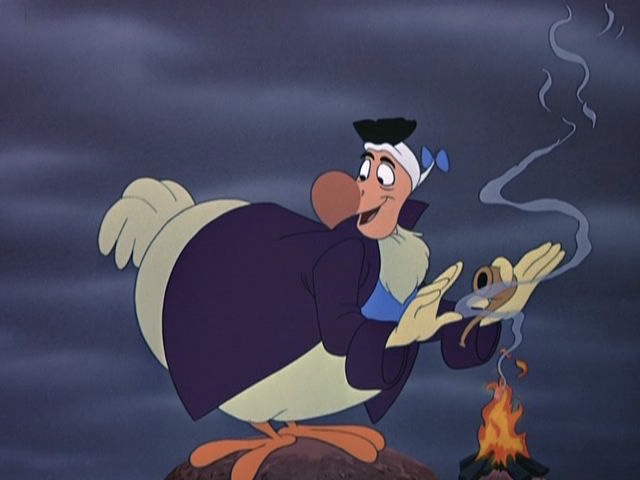
The dodo from Walt Disney's Alice In Wonderland; tell me this isn't a dead ringer for Chuck.
10. New Orleans Pelicans
Laissez les bon temps roulez, Pierre! I still love the Pels' name, mascot and mascot name. And pelicans can be fierce!

9. Atlanta Hawks
Harry the Hawk drops a spot this year as I suspected he might last year. The Atlanta Hawks new unis, as cool as the embossed diamond pattern on them is, are just awful with that neon yellow color. So until Harry ditches the current unis, he's unlikely to get higher than 9th anytime soon.

8. Oklahoma City Thunder
If Rumble the Bison moving up a notch in my mascot rank lessens the sting of Kevin Durant taking his talents the bay, then I'm happy for them. Of course, if it does, then the entire Thunder organization is missing the point. I'm sure they don't care where Rumble ends up on this list. Great look, great name and perfect embodiment of this franchise when it's oh so difficult to represent a noise as a team name.

7. San Antonio Spurs
6. Denver Nuggets
5. Milwaukee Bucks
4. Chicago Bulls

This Gang of Four is what I consider the NBA's classic mascots. Solid. Steady. Good looking. Repping their teams and/or cities legitimately. And those names: Benny. Bango (named after longtime play by play man Eddie Doucette's signature phrase). Rocky. And then there's The Coyote. Come on, San Antonio!! Really? Maybe the Raptors were just following your lead with their generic name hoping they would be as good. If there are mascot role models out there for aspiring NBA mascots, these guys are the nuts. After all that, there are still better mascots. Well, just three. But still. Better.

3. Orlando Magic
Top three time and this year's top three are exactly the same as last year's and the previous years. These three teams ain't messing with success and I'm not moving them down until they do or until someone comes up with a better mascot from teams four through 30.

Stuff the Magic Dragon continues to amaze me with how many layers of complexity this mascot boasts. It's mascot-ness is just simply genius. And I don't mean just that the name is awesome, the appearance is sound and it fits the team nickname. This is just an amazing mascot in the tradition of the Philadelphia Phillies' Philly Phanatic. It looks chaotic and does crazy stuff but it still manages to hold it's grace under pressure. Well done. Solid number three!

2. Charlotte Hornets
Hugo the Hornet down in Charlotte is sort of the anti-Stuff the Magic Dragon but he's got as much if not more going on. Where Stuff is crazy and out of control, Hugo is composed and never shaken. He's got it together at all times.

If there's a more successful re-brand of a sports team than Michael Jordan bringing the Hornets name back to Charlotte, I can't think of it. It was good before the team split for New Orleans more than a decade ago but the logo re-design and court re-design are spectacular. Hugo didn't get a lot of upgrades but they made him less cuddly which is OK. He's sort of a badass and he knows it.

1. Washington Wizards
So after all that, what can I say about G Wiz? He's simply the best again and likely always will be. I'll concede the team name, the team's logo and any sort of success year after pathetic year on the court, but I'm not giving up G Wiz's number on spot on this countdown. For me, G is the consummate team mascot for a team with the name Wizards. And his case is only made stronger by the (apparent) death of G Man, who I can't remember showing up at VC in a while and who I panned in my initial ranking.

Four years, four number one homer picks on this blog. In 2016, G Wiz takes the trophy again. Bring it on, rest of the NBA!


July 12, 2016

Where The Wizards Played: Chicago


In a normal year, I'd be just getting back from Las Vegas at this point in July, having spent a few days in the desert watching Washington Wizards Summer League hoops. I made my first Summer League trip in 2008 and was hooked immediately. Here was a new, more intimate way to see the NBA at work and I loved it instantly. Since that first trip, I've been every year except for 2011, when the lockout wiped out Summer League entirely.

But this is not a normal year as it turns out. After seven consecutive Summer Leagues I decided last year I'd give it a break for at least one year. Over the almost decade I'd been faithfully returning to Sin City, I'd seen the weeklong series of games get transformed from a hidden gem that not even the taxi drivers in Vegas knew about to a marquee destination for fans all over the southwest and beyond. In 2015, there were lines at the doors, packed seating areas and less of an ability to connect and chat with players, coaches and GMs. I'd had enough at least for one year. 

But I couldn't just bail on Summer League without getting out of the Washington, D.C. area. So this past weekend, I hopped a flight to Chicago for a couple of days out in the Windy City. And as a testament or a sinister indication of how completely the Wizards have permeated my life, I of course tracked down some sites which long ago meant something to this Wizards team.

The Wizards have changed their name as a franchise five times, more times than any other NBA club out there. For the last 53 seasons, the Wizards have been known (in sequence) as the Baltimore Bullets, Capital Bullets, Washington Bullets and Washington Wizards. Before that, the team was in Chicago. For just two seasons. They spent the 1961-1962 season as the Chicago Packers and the 1962-1963 season as the Chicago Zephyrs. I'm guessing the name change between the two seasons was made because no self respecting Chicago sports fan ever wants to chant "Let's go Packers!" A year after the Zephyrs started play, they were in Baltimore as the Bullets and there would be no more Packers or Zephyrs in the NBA. 

I've been to Chicago a few times before last week so I had checked off a number of my Chicago must see destinations. When I started putting my agenda together for this trip, I decided I should add the spot where the Wizards played those first two seasons to my list so I could go see where exactly the franchise started out. As it turned out, I had to go to two separate spots in the city because in addition to changing their name, they also switched arenas. I expected to find very little and that turned out to be almost true but I did find a couple of interesting sites which made this side trip totally worthwhile. 


1961-1962: Chicago Packers

How fitting would it be if the future Wizards played near the old Chicago Union Stock Yards which presumably inspired the Packers name? Well...very fitting would be the answer; perfect, even. And they did.

The Union Stock Yards were opened in 1865 in an area of Chicago right along the railroad which had previously been the location for various smaller stock yards used to hold cattle and pigs for slaughter prior to that time. With the creation of the Union Stock Yards, the railroad barons who owned and controlled the Yards created the largest single meat processing plant in the world and used their trains to distribute their product all over the Midwest and east coast. They also created an unsanitary dangerous place to work which employed the least powerful classes of people in Chicago, a situation which inspired Upton Sinclair to write The Jungle as a fiction-based-on-fact expose of the exploitation of workers in Chicago. Ultimately, his book had a huge influence on the labor movement in the United States in addition to giving rise to new health laws for operations involving food processing. It's also survived pretty well and is a good read.

In 1934 the Stock Yards built a building to host the 1934 International Livestock Exhibition and it was this facility, otherwise known as the International Amphitheater (postcard above), in which the Packers-Zephyrs-Bullets-Wizards franchise played their inaugural season's home games. It seated all of 9,000 for basketball and was used for that purpose for just the one season that the Packers played ball here. The building was closed in 1971, the same year the Stock Yards were closed, and it disappeared for good in 1999. 


International Amphitheatre site today.
Today the site is less than impressive. There's almost no memory of the Stock Yards around and there's an Aramark Uniform Services building on the block formerly occupied by the Amphitheatre. There's a Wizards tie-in here: Aramark is company that primarily supplies patrons like me with mediocre food and overpriced beer at Verizon Center. Appropriate, I guess, that the building they built here is about as exciting as I get about their food at Wizards games. It was better for me looking at the site to imagine the International Amphitheatre still in place. 

Where the Wizards played their first season is important to the history of Chicago and the United States and it has nothing to do with basketball. Head to the north and west of the old Amphitheatre site and you'll find the old main entrance to the Union Stock Yards, a gorgeous Richardson Romanesque arched structure that looks sufficiently important to announce the Stock Yards' presence. There's nothing else to do in this part of Chicago that I could see this past weekend but it's probably worth a look if you are ever in this area of town. 


1962-1963: Chicago Zephyrs

A year after they started playing at the International Amphitheatre, the Packers ditched their name and their home building and moved in to the Chicago Coliseum, which was located on South Wabash Avenue right at the intersection with East 14th Place. The Coliseum was one of the most infamous buildings in the United States back in its heyday, but that was when the building was a prison in Richmond, Virginia, not when it was an event venue in the Midwest.

Yep, that's right. A prison. The Coliseum (postcard above) began life as a warehouse by the side of the James River in Richmond, Virginia and the original construction date of the building is likely unknown. But in 1861 the Confederacy had started to use the building as a prison for Union officers and continued to use it for that purpose until 1864, the year before the Civil War ended. The Libby Prison, as it ended up being called, was probably second only to Camp Sumter in Andersonville, Georgia in terms of notoriety. And that's saying something. Andersonville was pretty much hell on Earth for the men who were held there.

Despite that background, someone cared so much about the building that he paid to have it dismantled and moved to Chicago. That someone was candy manufacturer Charles Gunther, who relocated the building in 1889 and opened it as the Libby Prison Civil War Museum. Ten years later, Gunther closed the museum and tore most of the building down and the Chicago Coliseum was born out of the rubble, so to speak. Part of the castellated wall of the façade was retained and integrated into the exterior of the building but the rest was gone.

The building was still standing as an events center when the Packers turned Zephyrs were looking for a new home in 1963. A little bit of refurbishment for the new tenant turned the Coliseum into a 7,000 seat venue for professional hoops. That was 2,000 fewer seats than the team had the first season, although I can't imagine that was a problem for the last placed Zephyrs: no attendance figures exist for the team but the NBA Champion Boston Celtics that year drew an average of fewer than 5,000 fans per contest.

Chicago Coliseum site today.
The Coliseum disappeared entirely in 1982, although a part of it is allegedly on display in the Chicago History Museum. Visit South Wabash and 14th Place today and you'll find a huge city block with a variety of buildings on the site, the perfect place for a basketball arena. The Coliseum has been replaced with the Soka-Gakkai International building. Soka-Gakkai is a Japanese based Buddhist group which bases its beliefs on the teachings of the 13th century Japanese priest Nichiren. File this in the "you learn something every day" category.

As a building site, the lot where the Coliseum stood is far more connected to the city of Chicago than the site where the Packers played. The old Stock Yards area has an industrial and abandoned feel; the Zephyrs had a home that is way more vibrant and bustling in present day Chicago. And just like the Stock Yards gate over by the International Amphitheatre, I found another spot worth visiting on this site: Vice District Brewing Company, an English ale style brewery with six offerings on tap which I enjoyed in a sampler before moving on to other weekend out of town activities.

My experience at Vice District was pretty standard. Six different brews, six three to four ounce sampler glasses sequenced from lightest to darkest. I'm a porter lover at heart but at Vice District I did not love the porter the best, finding it too coffee flavored. I'd uncharacteristically order the Kitchen Sink beer here, which is their lightest offering.

But in talking with the bartender (Howard University grad btw!) it appears the best is yet to come for Vice District and their brewmaster, who refreshingly is a woman (not the norm in the brewing industry). They have been in business two years but are planning an expansion with a production and canning facility on the south side of town in addition to some experimentation with sour ales, a much overlooked (in my opinion) Belgian brewing style. I'd love to go back once it's up and running.

Two years. Two names. Two buildings. And then basketball was gone from Chicago to Baltimore. Of course in 1966 Chicago got the Bulls, so tell me who got the better end of that deal. I can't necessarily recommend the two places the Wizards played in the Windy City as must sees when you are in the Midwest, but there's at least something interesting in both spots. Now I know where the Wizards started out. I somehow feel a bit more connected to the team and Chicago for it. Maybe I'll be back at Summer League next year. Then again, maybe not.

July 6, 2016

Do The Wizards Have A Fan Problem?


Before free agency talks began this offseason, the Washington Wizards had already lost out on their number one option. A couple of years ago at least half the Wizards fans out there had half talked themselves into the fantasy of homegrown basketball superstar Kevin Durant returning to the District to save our historically mediocre Wizards from continued mediocrity. Instead of considering his hometown team's pitch, Durant simply refused to even meet with the Wizards. Ouch!

When we got to day one of free agency, things didn't go a whole lot better. Sure, the team locked up Bradley Beal for the next five years (the cynic here would point out Beal really had two options: sign with the Wiz long term for a truckload of cash or take a risk on a one year qualifying offer and his health), but they missed on an in person meeting with one half of what appears to have been their plan B: the Charlotte Hornets' Nicolas Batum. He took a call from the Wizards but re-signed quickly with Charlotte. Then on day two day they whiffed on the second half of their plan B, the Atlanta Hawks' Al Horford. Three swings, three misses. Although let's face it, the franchise probably took the first strike looking.

As Wizards fans, I think we owe it to ourselves to ask the question "Why?" Why did three marquee players (maybe a stretch on Batum but still...) pass on the Wizards' money to go play elsewhere? I get that the Wizards missed the playoffs in 2016 after two straight second round appearances. But the team has a legitimate NBA starting lineup in place in three time All-Star John Wall; Beal; center Marcin Gortat; power forward Markieff Morris; and fourth year man Otto Porter, who admittedly might have been forced to come off the bench if either one of Durant, Batum or Horford had signed up for a season or more in D.C. Heck, when the team was engrossed in discussions with Horford they had already signed the Indiana Pacers' starting center Ian Mahinmi to come off the bench. Horford, in fact, according to one account actually preferred the Wizards personnel to the Celtics', the team with whom he ultimately signed. The lineup can't have been a problem.

So what's the deal? We have a brand new coach in place with NBA Finals pedigree so surely that's not the issue. We can guess at other factors like ownership (that has not, as yet, ventured enough over the salary cap to get itself into luxury tax territory) or management (which might have been around too long with no demonstrable track record of consistent success) that might have been involved in players' decisions not to sign with the Wizards. But nobody that turned the team down said anything to hint at that being the cause.

So maybe it's the fans who show up for games at Verizon Center. Seems crazy, right? Who on Earth would think that? Well, Kevin Durant, for one.

That's right, before his annual trip to D.C. on official business during this past season, Durant labeled the fans in Verizon Center "disrespectful" for cheering for him in an opponent's jersey, offering the opinion that the fans should be cheering for the players on the court for the Wizards. He then went on to declare "I wouldn't like it if I was on that team." 

So this is a one off thing, right? I mean players don't really think about this stuff, do they? Well, yes they do. In fact Al Horford in the last week cited the passion and enthusiasm of Celtics fans as a reason for choosing Boston as his new team rather than the Wizards or the Atlanta Hawks, a place where he'd spent his entire career but which admittedly suffers from some of the same things that Durant cited in his criticism of the VC crowd.

So all that brings me to the question: do the Wizards have a fan problem? I've read a number of things in the past week defending the fans in Verizon Center offering up the miserable record of Washington's basketball teams over the past three and a half plus decades as a credible defense. Most of these articles I've read place the blame squarely at the feet of the organization owned by Abe Pollin and now Ted Leonsis and of course there are some swipes at General Manager Ernie Grunfeld in there. My answer to the question I've asked earlier in this paragraph is "YES!" Because for sure, the Wizards have a fan problem. And it's enormous.

Let's get to the blame thing in a few minutes. The first step to solving any problem is admitting there is one in the first place. I believe there's a fan problem at Wizards home games. Anybody in the building listening to John Wall get booed at the free throw line at home against the Lakers; or hearing chants of "Go! Spurs! Go!" or "Let's go Celtics!" (or Knicks); or listening to Cleveland Cavaliers fans (read: former Miami Heat fans) making more noise than the hometown faithful during a Wizards-Cavs game has to acknowledge there's a fan problem at Verizon Center. The question is does the organization want to try to address this?

Now we can indulge in a couple of "what are Wizards fans supposed to do when the history of the organization is so bad" paragraphs. Yes, the Bullets and Wizards track record over the past 37 years is deplorable: no NBA titles, no conference titles, no division titles, no conference finals appearances and a maximum of 46 wins in a season. In that span of time, every current NBA city has experienced at least one 52 win season (Charlotte did it with the original Hornets) except Washington which is a full six wins shy in their ONE 46 win season.

For those of you longing for the good old days of the Bullets, let me disabuse of that notion. The last 18 Bullets seasons featured just one second round playoff appearance and a maximum of 43 wins in a season. The Wizards in their 19 seasons have made three second round playoff appearances and have won 43 games in a season for times. Bullets or Wizards aside, all this adds up to generations (and I don't use that term lightly but I really mean it) of disaffected Washington basketball fans. I agree with all those who blame the organization for this problem. I don't necessarily hold the fans blameless because I (and many tens of others) manage to show up almost every game and root for the Wizard and NEVER NEVER for any opposition player, no matter how much of a superstar he is.


But enough blaming. Back to the solution and does the organization want to take steps to do anything about this. And let's take the obvious solution off the table which is build a championship squad that everyone in the DMV will love, cheer on with reckless abandon and pay gobs and gobs of money to watch play in person. Don't get me wrong, it's a great solution but right now it's a bit pie in the sky and we need a solution like right now. I don't want to be drowned out by Clippers fans (we would scoff at this notion ten years ago, right?) at too many more home Wizards games. The issue for me is how do we get more noise in the building, ideally by getting Wizards fans to show up and kicking opposing fans (or "fans" if you prefer) out of the building.

These issues are not unique to the Wizards. Some NBA teams (will the Boston Celtics and the Miami Heat please stand up!) have solved the noise issue by piping in fake cheering over the building's sound system. Yep, that's right there are some games in Beantown or south Florida where you can hear tons of noise on TV while the crowd is obviously sitting there making no noise. Please don't do this, Wizards. It may be effective but it lacks a certain authenticity. 

Increasing noise artificially is one thing; stopping opponents fans making noise is another. There's really no way to get at this but to take those fans out of the building. Some teams have taken a somewhat authoritarian tact towards other teams' fans. The NHL's Tampa Bay Lightning has prohibited the wearing of opponents' jerseys during Lighting home games either in certain sections or the whole arena during the playoffs. While effective at keeping visitor swag out of the building, it doesn't solve the problem of opponents' fans in the building and it seems a little gestapo-like. Not a fan of the Wizards doing this either.

The biggest problem for me is the availability of secondary market tickets which allow opposing team fans to cherry pick quality seats (and let's be honest here a lot of the sellers are season ticket holders) and show up in force to root against the Wizards. Some teams have taken measures to combat secondary market sales by season ticket holders. Some NBA and NFL teams have either restricted season ticket sales or secondary market sales through official outlets to addresses within the immediate vicinity of the home city. The New York Yankees have restricted resale minimums to a certain percentage of the season ticket holder cost in some sections. This could work to get Wizards fans into the building. Imagine how many season ticket holders when forced to sell their Wednesday Utah Jazz tickets at half face value might opt to go to the game instead of eating the cost (because let's face it, Wednesday against the Jazz ain't selling for anything but the bare minimum).


So not being a guy to throw around criticism without offering up a solution, here's my idea: incentivize Wizards season ticket holders to show up by offering deep discounts over gate prices and prohibiting secondary market sales. I know what you are thinking. I'm crazy, right? Bear with me. And I'm not thinking of a system where season ticket holders earn rewards points but can't ever redeem them for anything useful; that system already exists.

Right now Wizards season ticket holders get a minimal discount over the gate price but have the freedom to sell tickets on either official or unofficial ticket resale sites. Some fans, I'm sure, go to some games they want to but when there's money to be made they are happy to sell their tickets in great location to fans of the visiting teams if it lines their pockets a bit. These extra bucks might allow them to skip some mid-week games against un-popular teams and watch from the comfort of their sofa at home. The result? Opposing fans of good teams at Verizon Center and an empty building mid-week when the Milwaukee Bucks are in town.

So why not change it up a bit? Why not offer season ticket holders the option of buying further discounted ticket plans with a prohibition on selling on the secondary market? Can't be done because there are too many ways to sell tickets these days, you say? Well what if the customers opting for this plan could only use an electronic card (the Wizards already issue these for season ticket holders) with no option to print at home or transfer tickets to friends or post for sale on a resale site? Sure season ticket holders could sell the card issued to them but what are the odds it gets returned after that buyer has used it?

I know this might seem extreme or marginally useful but at least it will force Wizards season ticket holders to show up for Cleveland or Golden State or San Antonio or Oklahoma City games. Either that or they just stay at home and their seats are vacant. Better an empty seat than a Cavaliers or Warriors or Spurs or Thunder fan in it. The discounts would have to be deep here and I know the concept sounds particularly un-American but we need some extreme solutions to our fan problem.

I know there are downsides to the organization with this idea. They would be further discounting season tickets for some fans and we know from the last couple of year how the current ownership likes to raise ticket prices. But look, this is a bit of a crisis and desperate times call for desperate measures. At this time in the franchise's history, the Wizards NEED more fans that show up every night. Each of the three photographs in this post were taken by me right before tipoff of a Wizards home game in the last two years. We have a serious fan problem. No matter who we blame for it, it exists. We may need an extreme solution.

June 25, 2016

Fun While It Lasted


Summer is a difficult time for me to blog about the Wizards. Other than the NBA Draft in June (no picks this year), Summer League in July (not going this year) and the release of the next season's schedule in August, there is precious little for me to write about. So every so often I've saved a blog post for the summer because it appeared that there was relatively little urgency to writing about the chosen subject. This is one of those blog posts. Sometimes those blog posts lack the relevance they would have had if I'd posted them earlier. This is also one of those blog posts.

This past February, Monumental Sports and Entertainment (the group that owns the Wizards, Mystics and Capitals) announced a partnership with FanPics, a company that takes photographs of crowds during sporting events. I know, right? Keep reading. From what I can gather, FanPics installed a series of cameras somewhere near the middle of the arena (I'm assuming on the scoreboard) which at certain times during the game takes a photograph of the entire crowd at Verizon Center for a Wizards or Capitals game. This shutter is apparently operated by a person who is supposed to select certain eventful times in the game when the crowd might be especially energized. I figured this part out because there was a call for applicants posted on the company's site earlier this year.

Once the photographs are taken, they are made immediately available to all fans for free. Their app even has a feature which will email a picture of you based on your seat assignment to you during the game so (I guess) you can re-post to your social media of choice instantly. In case you are catching up here, FanPics somehow made an agreement with the Wizards to install equipment (which presumably costs money) at Verizon Center; they will then pay someone a wage to man their camera system; and the products of their labors are made available absolutely free to anyone. I have to admit I was struggling to understand this business model.

Pretty sure I'm calling a charge here. Although I might be trying to poke Mike in the face.
In early April I finally had some time to check out FanPics so I made an account, punched in my seat location and lo and behold, there I am watching the Wizards over the course of the last couple of months worth of games. Most of the photographs were a little fuzzy but there were some pretty good ones of me watching hoops, which admittedly is about as exciting as watching paint dry. I'm posting the three I consider as the best of the bunch here, which feature me in my John Wall jersey doing some kind of air pull-up; me gesticulating wildly to my right while my friend Mike sits next to me stone-faced; and Mike and I high-fiving.

I thought before I wrote this post I'd go back and pick up the last few games of the season and see if there were any better shots. But when I tried my sign in information, it didn't work. I tried re-setting my password and that didn't work either. So I tried making a new account with a different email address and failed at that too. Puzzled, I thought I might try to contact FanPics with a question so I checked their Facebook page (last post March 10, 2016) and their Twitter feed (last tweet March 18, 2016). After all that, I'm not sure they exist anymore, which totally makes sense since I had no idea how these people would ever make money. Even if they were to sell pictures instead of giving them away, I still couldn't imagine that being worth the investment. Well, it was fun for the month or so that it lasted, right? Maybe they are still around. I've never said I was the best with technology but I'm pretty sure I can make and maintain a FanPics account.

Whether or not FanPics is truly dead I guess doesn't mean much to me either way, but in the photo below, they have done something remarkable. I think they have sort of crystallized my Wizards fandom into a single image. It's a little out of focus, which is both annoying but also somehow perfect at the same time. We're obviously playing the New York Knicks (because I remember the annoying dude behind us in the Carmelo Anthony jersey right up until the time he left early) and Mike and I are super happy about something exciting enough to stand up and high five each other (and I'm assuming it's not Mike getting a new Bud Light).

In the meantime, nobody, and I REALLY mean nobody, is the least bit excited about what's happening. There are a couple of dudes two rows behind us that look like they are clapping politely but most of the other people are barely paying attention to the game. What the heck is going on? I'm so pumped up that my fist is clenched. But this is my live experience at a Wizards home game in a nutshell. No other picture could more perfectly sum up the atmosphere I feel most games at Verizon Center. It's almost like I feel I'm doing something wrong by making noise when the Wizards do good things. If that's my lot in life, so be it. I'm not going to stop cheering, even if nobody else will. RIP FanPics, if you are truly dead.

June 21, 2016

Get Lucky!


Let's start this blog post with a test. Raise your hand if you think Ernie Grunfeld is a below average NBA general manager. Keep your hand up if your judgment is based in whole or in part on his drafting history. I'm guessing a lot of people reading this have at least one hand up. If you do, is it because he drafted Oleksiy Pecherov, Nick Young and JaVale McGee in the first round of successive drafts or is it because he selected Jan Vesely over Klay Thompson, Tomas Satoransky over Draymond Green and traded a pick that he could have used on Stephen Curry? Put both hands up if it's all of the above. Pretty damning, right? I mean this guy really doesn't know what he's doing.

So who do you think drafts well? How about the Golden State Warriors, since in the last seven drafts they've selected Stephen Curry (2009), Klay Thompson (2011), Harrison Barnes (2012), Festus Ezili (2012) and Draymond Green (2012)? All five are still with the team and three of the five (Curry, Thompson and Green) have made at least one NBA All-Star Game, not to mention Curry being named MVP of the league two years in a row and the franchise appearing in the last two NBA Finals (winning just one thanks to Keke Vandeweghe).

Sounds pretty good, right? Never mind the fact that there was a different general manager in place in 2009/2011 vs. 2012 and that the same guy who drafted Stephen Curry in 2009 selected Epke Udoh with the number six overall pick a year later. And if anyone thinks the strategy used by the Warriors to select Draymond Green with the 35th pick in the 2012 Draft was genius, consider that if they had to do it all over again, they might select him over Harrison Barnes at the seven spot but they would for sure certainly pick Draymond ahead of Festus Ezeli five picks earlier. Draymond's game only took off after he lost 20 pounds one year after he was drafted. The Dubs for sure got some good bounces on this stuff.

Let's try another test. Raise your hand if you would have selected Kevin Durant over Greg Oden with the number one overall pick in 2007. Or Marc Gasol over Nick Young that same year. Raise your hand or keep it up if you would have grabbed Russell Westbrook over O.J. Mayo or Michael Beasley the very next year. What about in 2011? Raise one hand if you would have picked Kawhi Leonard, two for Jimmy Butler or zero for Derrick Williams if you have the number two overall pick. Did you have at least one hand raised throughout this paragraph? If you did, I say you are lying or your memory is really short.

In the 2007 Draft, at least half of the teams would have selected Oden over Durant. Heck, the Seattle SuperSonics might have selected Oden if they were unlucky enough (as it turned out) to have the number one spot that year. Know how many teams passed on Marc Gasol? 25, including the Los Angeles Lakers who drafted him. But only after they picked up Javaris Crittenton and Sun Yue before him. In 2008 the whole debate about who goes number one centered around Michael Beasley and Derrick Rose; Russell Westbrook was NEVER an option. And Leonard (drafted 15th) and Butler (drafted 30th) would never in a million years have been selected by any team ahead of Derrick Williams in 2011. Discussing anything else is revisionist history.

Let's get back to Ernie Grunfeld. Assuming he still trades the 2009 five pick for Randy Foye and Mike Miller (total bust of course), he still could have drafted Rajon Rondo or Paul Millsap or Kyle Lowry in 2006 instead of Pecherov; Klay Thompson, Kawhi Leonard or Jimmy Butler in 2011 instead of Vesely; and then of course Draymond Green over Tomas Satoransky in 2012. But who's he supposed to take in 2007 instead of Nick Young? Al Thornton? Acie Law? Julian Wright? Oh wait, all those guys were gone already. What about Daequan Cook? Wilson Chandler? Morris Almond? I mean I get Mo Almond was about the most successful Wizard ever (6-0 record) but look at the list and tell me who he's supposed to pick with the benefit of hindsight. That year was just a bad year.

What about John Wall? That pick was pretty good, don't you think? Would you rather have Evan Turner, who was really the only other option at number one anyway? The answer is no. You might say you want Paul George or DeMarcus Cousins but you wouldn't have claimed that so articulately back in 2010. And don't tell me Grunfeld had no other choice but to take Wall and therefore gets no credit whatsoever because there was another choice. There's were tons of other choices.

Should we pick on the Bradley Beal or Otto Porter picks? The Wizards could have Steven Adams or C.J. McCollum instead of Otto. Or Damian Lillard or Andre Drummond instead of Beal. At this point, is there really that much of a difference here? Remember the Wizards could have opted for Thomas Robinson (selected ahead of Lillard and Drummond) or Ben McLemore (picked ahead of McCollum and Adams) but didn't. Yes, Lillard and Drummond have made the All-Star Game but Derrick Rose won an MVP and can't stay on the court any more. Wait a few years before you start picking on Beal and Porter.

So what's the point here? Well, it's certainly not to exonerate Ernie Grunfeld for all his past draft mistakes because for sure there have been some (Pecherov sticks out really badly to me). But it is to remind everyone that we can't just go back and re-write history to complain about what ifs using the absolute best possible outcome from every draft year. It doesn't work that way. Do you remember how Grunfeld got trashed for picking Vesely in 2011? No? Know why? Because he didn't.
Fox Sports and NBADraft.net gave the Wizards a B that year; Sports Illustrated's Sam Amick and Ball Don't Lie gave the Wiz an A+. A+!!!!! For Vesely, Singleton and Mack. Everyone that year was convinced the Wizards needed an athletic big man to run with John Wall and plenty of people loved Jan Vesely in that role. Nobody knew that pick was going to turn out horribly.

When the selections start Thursday night, rest assured there are about a million mock drafts out there that all look relatively similar. And if any team picks much outside that order, whatever general manager has dared to deviate from the plan will get immediately crucified like the second coming of the Kristaps Porzingis pick last year. Oh wait a minute...so far that pick's looking pretty good. There's no crystal ball, no surefire thing. There's a ton of luck and things breaking the right way here. And there are a lot of things to derail any exciting draft pick.

At the end of the Draft this week, every team is going to go home convinced they did the best they could and they made some smart picks (well, maybe not the Wizards because we don't have any picks). But we won't really know until next season, or the season after or maybe five or six seasons from now. There's so much luck involved in this process. Well, unless maybe you select Jonny Flynn fifth overall...because what was David Kahn thinking that year? Don't overreact to anything about the Draft this week. It's a little bit of a crap shoot after all. Sometimes you win, sometimes you lose. And sometimes you have to wait a while to find out.
 
Jonny Flynn...we hardly knew ye.

June 19, 2016

Season Tickets vs. StubHub? 2016 Report


It's almost the end of June. The NBA season is over tonight. The NBA Draft is Thursday and everyone's looking forward to the start of free agency. And free agency is all the diehard Wizards fan has had to look forward to for the last two plus months. Let's get this thing started and move on to the 2016-2017 season. But before I put last season to rest for good, it's time for my third annual secondary market ticket pricing report. Spoiler alert here: Wizards fans should feel less positive about their season ticket purchase last year than the prior two years. Success on the court and rising prices are the likely culprits here.

To refresh everyone's memory or to introduce newcomers to the concept, for the past three seasons I've tracked the price of Wizards tickets on the secondary market. I published my first set of results two years ago; last year I did the same thing. Since I realize there's only so much we can stand to read in our ADD world these days, let me summarize the results the last two years on a big picture level.

For an upper deck seat in the front of the center five sections of Verizon Center, buying Wizards season tickets represented a 25% savings over the secondary market during the 2013-2014 NBA season and a 46% savings one year later. For a lower level seat in the front of the center five sections of Verizon Center, buying Wizards season tickets in a corner section represented a 30% savings over the secondary market during the 2013-2014 NBA season and a 48% one year later. The cost savings increase was remarkable between the two seasons because the saving increased despite the Wizards deciding to raise prices for most seats in 2014.

Got that? Good! Now before we get to last season's numbers,  perhaps a little perspective is in order. First, I changed the conditions of the experiment a little bit. The last two years I tracked pricing at two different points in time: once about a week ahead of gameday and once on the day of the game. I decided that the results yielded by that tracking provided me with no useful data so I abandoned it completely. I am doing this primarily to understand if I am getting the kind of value I need out of my season tickets; tracking pricing at two different points in time for every game didn't significantly change that evaluation for me.

Secondly, both StubHub and Ticketmaster this year provided total price information without having to move beyond the initial stadium screenshot (previously StubHub was the only one doing this). Because they did, I tracked pricing on both sites and can report that information for both the consumer and the seller here today.

Thirdly, just like in 2014, the Wizards again raised prices in 2015 (as they did this year too). For the comparison offered here (which are the specific seats I purchase) there was a 20% increase in lower level tickets and a 40% increase in upper level tickets. A 40% ticket price increase with no corresponding increase in secondary market prices might wipe out the savings promised by the team as part of their season ticket sales pitch.

Finally, there's no playoff comparison this year. Why is that? Because the team didn't make the playoffs this year. Next year, Wizards fans will be paying out more money on the promise of getting better. We'll see how that works out for us.

Ticketmaster's enhanced pricing feature, showing prices with all fees from the first screen.
So after all that, let's see how the secondary market compared to the discounted season ticket pricing. Just like the last two years I've done this, I'm comparing the price of similar location secondary market tickets to my specific season ticket locations. For the lower level, that means the first ten rows of the center five sections; upstairs, that means the first seven rows of the center five sections.

  • Purchasing Section 109, Row E seats for the entire 2015-2016 season cost me $2,805. Purchasing equivalent seats on StubHub for each and every regular season game (no preseason; preseason has no value) would have cost me $3,930. Season tickets are 29% cheaper. That's a lot different than the 48% I reported last year.
  • Purchasing Section 415, Row C seats for the entire 2015-2016 season cost me $1,190. Purchasing equivalent seats on StubHub for each and every regular season game (again, no preseason) would have cost me $1,440. Season tickets are 17% cheaper. Just like in the lower level but actually way worse, that's a lot different than the 46% I reported last year.
 
The results above are just for StubHub. For tickets on Ticketmaster's site, including their resale NBAtickets.com site, secondary prices are a little higher: on average 6% higher in the lower bowl and 10% in the upper deck. That doesn't wholly surprise me: when you buy on Ticketmaster you are getting a guaranteed ticket. As awesome as StubHub's customer service is and as many times I have bought tickets off their site without any problem whatsoever, they can't guarantee the seat you buy is authentic because they don't own the original ticket.

Concentrating on the StubHub pricing only, secondary market tickets during the 2014-2015 season cost an average of $109 in the 100 level and $38 upstairs at Verizon Center. Last season, these numbers were $96 and $35 respectively. So secondary market pricing for Wizards tickets dropped even though the team raised prices. Next year better be a really good one for the Wizards, since my 109 seats suffered a 21% increase in price this past February. The Wizards (and I) can't afford another price drop on the secondary market. If that trend continues, pretty soon my tickets will be more expensive than the resale market, despite the advertised benefit of cheaper than gate prices.

The results above consider attendance at all 41 home games. Most fans don't do that. Some only go on weekdays after work; some go only on weekends when they have more time; and some just pick the best opponents to go see. It's important therefore to consider pricing of other scenarios, which I've done each of the past two years as well. Last year, looking at some different scenarios yielded consistently good results for Wizards season ticket holders. This year, the lower level made out fine: any of the three scenarios listed earlier in this paragraph showed at least a 29% savings vs. the secondary market.

Not so much in the upper deck. Upper deck tickets against the best teams in the NBA (the four conference finalists) were a bargain for season ticket holders. But attending weeknight games (Monday through Thursday) was not. In this scenario, season ticket holders were afforded only a 15 % savings over the secondary market. Considering the Golden State game and one of the two Cleveland games were on a weeknight, that's troubling. That means there were a lot of weeknight games in the upper deck which had essentially no value whatsoever. That matches my personal experience last year. There were lots of weeknight games I could neither give away nor sell tickets to.

As I've already mentioned, one of the advertised benefits of being a Wizards season ticket holder is the opportunity to purchase tickets at a discount, although the specific discount over the gate price is never written down. This should be a benefit for a couple of reasons. First, if you can buy tickets overall cheaper on the secondary market why would you ever buy season tickets unless you really loved other benefits or were really attached to your seats. Secondly, diehard fans can't possibly be expected to pay the supply and demand secondary market price for every game. The reason why some games are more expensive than gate prices is that there are folks out there willing to pay a lot of money to go to just the one game they want to go to. Season ticket holders would never be able to afford that scenario for every game. The discount is a key to retaining diehard fans who show up game after game no matter who or how well our team is playing.

So what does this all mean for Wizards season ticket holder subjected to yet another price hike? Well for one, your season tickets are likely still cheaper than secondary market prices but the team better perform better than they did last year or it might be that way for long. The results this year represent for me a reversal in trending. It also means based on last year's data that you are for sure paying more than some dude buying off StubHub for a midweek game against Brooklyn, Milwaukee or some similarly undesirable (read: they have no committed fans either) team. Skipping these games surely means selling at a big loss or eating the cost entirely.

I re-upped both sets of my season tickets this year but I thought hard about it. I actually considered just renewing my upper level seats and then buying selectively a la carte on the secondary market to a predetermined overall spend limit that I would be comfortable with. I thought that would allow me to watch a lot of games in the lower level during weekdays against weaker teams (including a VIP game or two) based on a depressed market and lower my overall spend. That's an idea I might reconsider each year, especially since I know prices will continue to likely rise all over the arena. For now, I believe season tickets are a bit cheaper but as those prices get higher and higher, other options become way more attractive. All we need now is a couple of franchise altering free agents. Ha!


Want to see the Wiz vs. Nets this past April upstairs? $11 would get you in. Season ticket holders paid $28! Ouch!